









When Chris Nickell and Brenda Gonzalez started Finca Seremos—Spanish for “We Will be Farms”—they were driving more than an hour each way to a rented acre of land near Beacon. The land came through a friend of a friend. It had no irrigation, no lease security, and eventually, no future. “It was punishing,” says Nickell, who also works with the Farmer Housing Working Group. The couple’s experience—harassment, displacement, and housing instability—reveals how even the most dedicated farmers can be pushed to the brink by the Hudson Valley’s unforgiving mix of rising rents, land scarcity, and systemic neglect.
Eventually, they moved into a small apartment in Newburgh—$2,100 a month, more than they could comfortably afford. Nickell says while the rent was high, the heating was faulty.
Meanwhile, issues on the farm escalated. The landowner failed to provide irrigation water specified in the lease. Things turned hostile when Nickell and Gonzalez pushed back, threatening to withhold rent if there was no water by May. “She had a meltdown, sending us repeated nasty emails, yelling at us when we were on the land,” Nickell says.
A relative of the landlord who lived on the adjoining lot regularly shouted homophobic, transphobic, and racist slurs at the couple and their guests. “All of this felt frustrating and, at times, unsafe,” Nickell says.
Nickell and Gonzalez moved off the land by the end of December, scrambling to find new space to grow. A potential intergenerational land transfer in Sullivan County seemed promising—until it fell through just days after they signed a lease.

Chris Nickell transplants seedlings in the greenhouse on their new farm, marking the start of the growing season and a hard-won step forward in their journey toward land and housing stability.
The couple finally found a measure of stability in Liberty, working a three-acre plot rented from another farmer across the valley and paying $1,400 for a 2-bedroom apartment they found through a friend. But Nickell and Gonzalez are still looking for long-term land security—and trying to recover from the toll of constant upheaval and burnout. “We weren’t able to rest at all,” Nickell says.
Their story is not an outlier, but a reflection of deeper cracks in the Hudson Valley’s housing and land systems, where beginning farmers face structural, legal, and financial barriers to doing the work their communities depend on: growing food.
Barriers to Accessing Land and Housing
Across the Hudson Valley, farmers and farmworkers are being priced out of their land and homes. “Many people who have stable housing don’t understand the issues of rural housing and land insecurity,” Nickell says. “They think it means living in dilapidated, run-down, ramshackle housing. It certainly can mean this, but insecurity can also be caused by unstable wages, unpredictable rent hikes, and landlord harassment.”
The situation is even more challenging for low-income farmers. Farmworkers in the US earn an average of $16.62 per hour—far below the national average wage. In New York, many earn even less. This income gap severely limits their ability to afford housing near the farms where they labor, let alone save for land or invest in infrastructure. This leads to farmworkers often living in overcrowded living conditions, facing long commutes, and the constant threat of displacement, Nickell says.

But income is just one piece of a larger puzzle. Shaniqua Bowden, the director of cultural engagement and sustainable living at the Kingston Land Trust, says real estate prices have soared, grant funding is increasingly competitive and bureaucratic, not-in-my-backyard resistance is an issue, with many supporting affordable housing in theory by resisting projects in their neighborhoods, and zoning laws across the region—often designed to restrict development—routinely block the construction of on-farm housing or multi-family dwellings that could meet agricultural needs.
These challenges hit farmers of color especially hard. Over 253,000 acres of farmland disappeared from New York between 2001 and 2016, disproportionately affecting small and BIPOC-owned farms.

“Even after securing land, Black farmers face resistance from local governments, financial institutions, and neighbor harassment, making it harder to build sustainable farm operations,” Bowden says. “How can we create a thriving ecosystem where farmers can make a living, have stability, and the land is honored and stewarded in alignment with ecological and social justice principles?” she asks.
The Role of Land Trusts
This is where organizations like the Kingston Land Trust and Hudson Highlands Land Trust step in. These land trusts are working to bridge the gap between land preservation and housing access for young farmers like Nickell. Land trusts, traditionally focused on conserving natural spaces and agricultural land, are nonprofit organizations that acquire or protect land through easements, donations, or purchases. Increasingly, they’re finding themselves at the center of conversations about housing. “Affordable housing and conservation are interconnected at the focal point of land use decisions,” says Edward Warren, the public policy manager at HHLT. “To try and solve either of these issues without considering the other is to not see the big picture.”
Each color on this map designates a specific use for land on Cookingham Farm: farmland, reserved building areas, resource protection, resource stewardship, and affordable housing development. Map courtesy of Town of Red Hook.
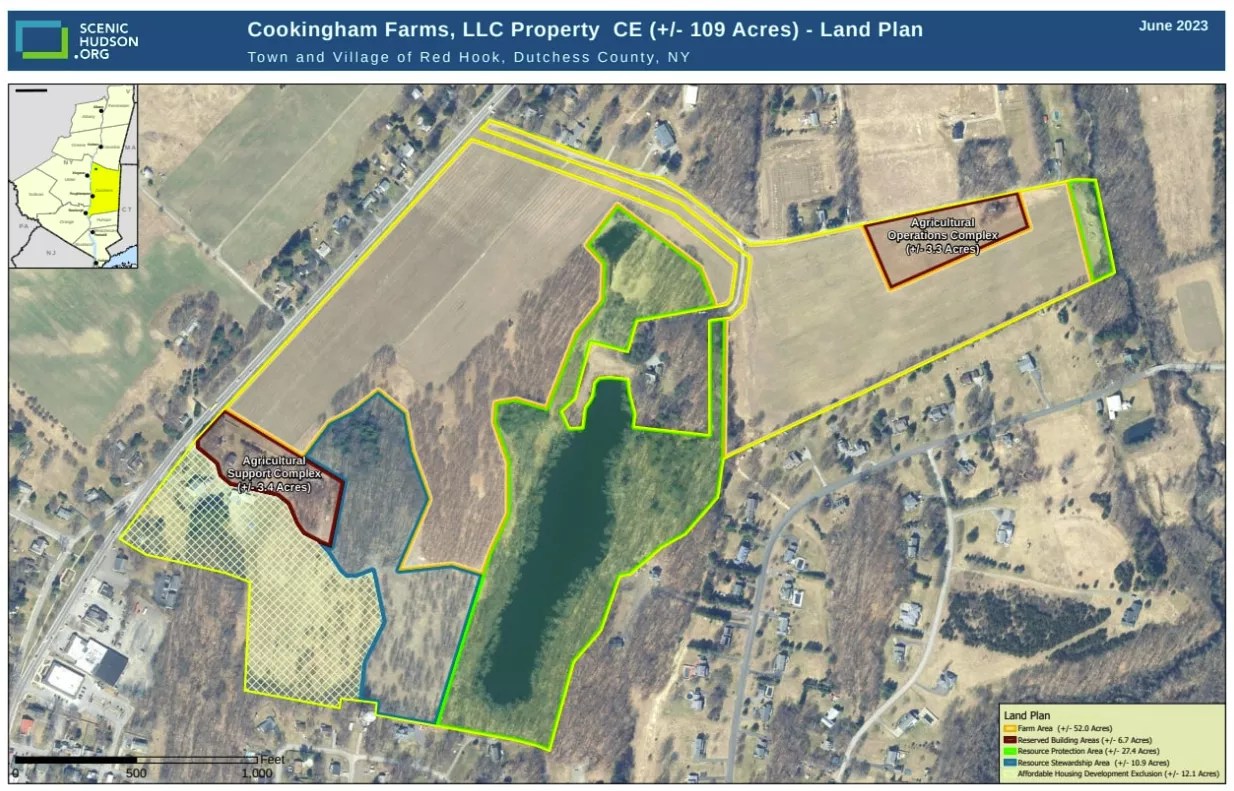
One promising example of what this collaboration can look like is the Cookingham Farm Project in Red Hook—a model many hope to replicate. The farm was conserved through an agricultural easement, and the funds generated from that process are now being used to build clustered, energy-efficient, and affordable housing on a portion of the land. “The Cookingham Farm project demonstrates how the work of two sectors, too often perceived as being in conflict, are actually very well aligned,” says Steve Rosenberg, co-convener of the Hudson Valley Alliance for Housing and Conservation, which brings together eight conservation and eight housing organizations.
But land trusts face real constraints and tight operational funding. As nonprofits, many land trusts rely on fundraising through competitive grants or community donations and partnerships to secure properties, implement programs, and pay their staff. Another challenge is that many conservation easements prohibit new development, even for farmer housing. Typical low-density rural residential zoning codes restrict building multiple dwellings on preserved farmland. “Not only are we losing farmland to this type of unsustainable, automobile-dependent development, the farms that are left are surrounded by housing options that are financially out of reach to their workforce,” Warren says.
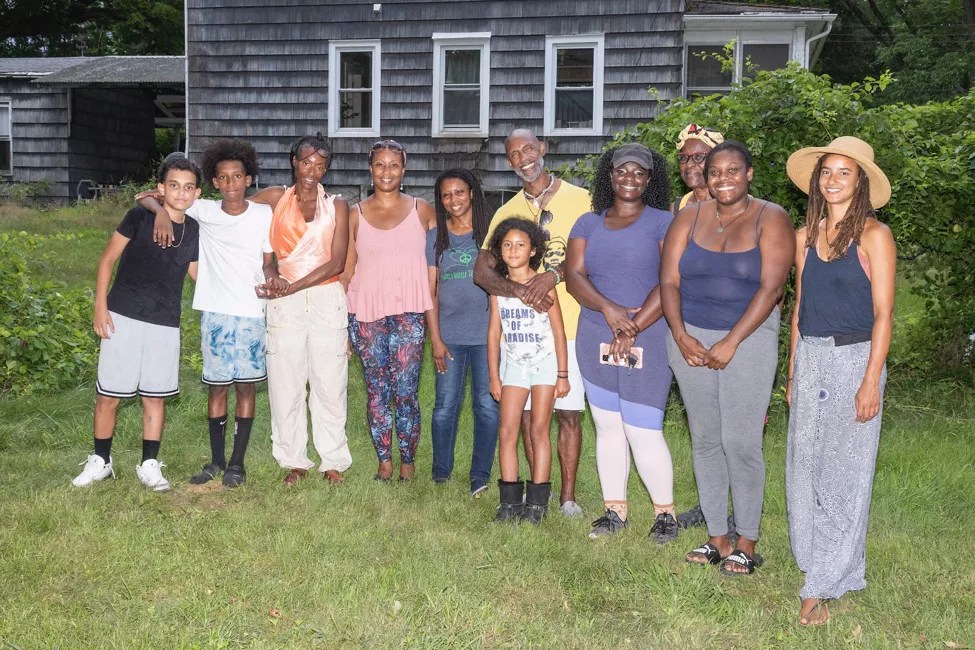
That’s why groups like KLT, with projects like Land in Black Hands, are working closely with municipal planners, larger land trusts, housing advocates at FHWG, and local developers to create housing on protected land, advocating for accessory dwelling units and flexible zoning to make it possible.
“Our vision is to create a space that supports small-scale farmers, land stewards, and those seeking to grow their own food, rather than just offering a transactional housing solution,” Bowden says. “Land should be used in service to people and the environment, and that means thinking about housing, food production, land access, and habitat preservation as interconnected.”
The Need for Legislative Action
Nickell notes that even with land trusts in place, the need for funding and political support remains high. Land trusts require stable funding to acquire and maintain land. They also need to navigate the complex legal and zoning frameworks that govern land use. While land trusts like KLT and HHLT are making strides, the systemic challenges that farmers face require more than just localized solutions. As Nickell points out, policy changes are essential to ensure that land access and housing are equitable for everyone, not just those with wealth or political connections.
Nickell calls for stronger zoning reform, tenant protections, municipal community housing funds, agricultural housing research and protection plans, and expanded state and federal funding.
One promising bill in New York, S01718-A/A00355-A, would allow land trusts to hold state funding for permanently affordable farmworker housing. Bowden explains that if the bill passes, municipalities will have the option to offer property tax exemptions between 25 percent and 75 percent. “This legislation shapes agricultural policy, rural development, and housing initiatives that directly impact those who grow our food,” she says.
Moving Toward an Equitable Future
Nickell envisions a future where food and housing are no longer commodities subjected to speculative forces. “We need to start by fairly valuing food and the workers who grow it,” they say. For Nickell, this means supporting farmers as skilled professionals, which would spark a ripple effect across industries, raising wages and making high-quality, culturally relevant food accessible to all.
This vision is shared by others in the movement, including Bowden, who emphasizes that the challenges we face—from climate change to housing insecurity—are not just policy issues but require a deep cultural transformation. “We have everything we need if we come together, pool our knowledge, and share our resources,” she says.
This collective action is already taking root in initiatives like the Cookingham Farm Project, which combines farmland preservation with affordable housing solutions. The hope for the future lies in expanding these efforts, advocating for policies that incentivize land access, and fostering partnerships between land trusts, farmers, and community organizations. By integrating these values into broader policy and cultural frameworks, the Hudson Valley could become a model for a more equitable and sustainable agricultural future.
This article appears in May 2025.

The River is an independent news outlet that produces in-depth, quality journalism and analysis about the Hudson Valley and Catskills regions. Learn more about our mission and ethics.


