









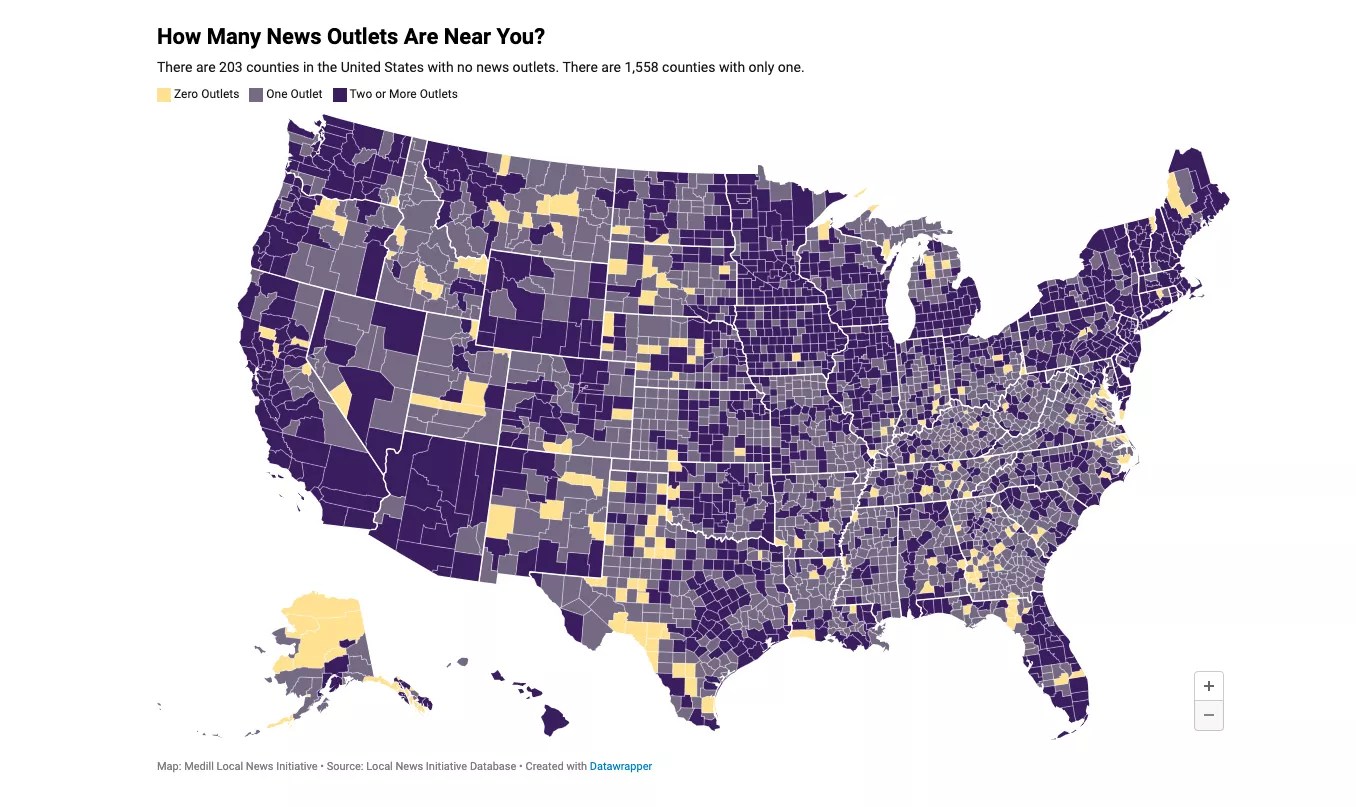
It can be difficult to tell just how bad the journalism business has gotten, but statistics don’t paint a rosy picture. According to Northwestern University’s State of Local News Project, published last November, the United States has lost nearly 3,000 newspapers and 43,000 newspaper journalists in the last two decades, and residents in more than half of American counties have limited or no local news source.
These aren’t just national trends: the Hudson Valley has faced its own changes in the local media landscape, including the pandemic-era shutdown of the Ulster Publishing newspapers and consolidation into Hudson Valley One, heavy layoffs at the Gannett-owned Journal News and Times Herald-Record, and just this year the abrupt closure of three long-term Westchester weeklies, the Scarsdale Inquirer, Record-Review, and Rivertowns Enterprise.
Still, the portrait of local media in terminal decline isn’t exactly accurate. In the midst of a highly challenging landscape, new outlets have sprung up and older ones have endured, both seeking out innovative ways to counteract the industry’s downward spiral and produce compelling local reporting for a still-interested public.
Potentially aiding this effort, New York state’s 2025 budget will include, for the first time, tax credits for local journalism—$90 million over three years. How much support this legislation can offer small outlets remains to be seen, as does a broader, more regionally specific question: Is there a sustainable path forward for local media in the Hudson Valley?
New York’s Tax Credits
Tax credits to support journalism have been one of several government interventions proposed to stop the industry’s collapse and subsidize access to local news. The Local Journalism Sustainability Act—which would offer tax credits for newspaper subscriptions, journalistic employment, and advertising in local media—was introduced in Congress in 2020, but has not been voted on. Meanwhile, several localities—including California, New Mexico, New Jersey, and Washington, DC—have passed bills that provide various methods of funding local journalism, from vouchers for donations to fellowship and internship programs for local coverage.
But New York’s effort is the largest state or municipal investment thus far in local journalism. The legislation, amounting to $90 million—or $30 million annually for three years—allows outlets to receive a 50 percent refundable tax credit for the first $50,000 of a journalist’s salary, at up to $300,000 per organization. The program is geared toward both incentivizing hiring of new journalists and retaining working journalists, with $26 million annually designed to be split 50-50 between organizations with greater or fewer than 100 employees. Each year, $4 million will be set aside to specifically incentivize hiring new journalists.
Media Efforts in the Hudson Valley
While the legislation has some potential problems—more on those below—many local publishers are supportive, at least in principle. This includes Alex Shiffer, publisher of the Shawangunk Journal and Kingston Wire.
“I think it’s great,” says Shiffer. “It’s an acknowledgement that local news now has really become a civic kind of endeavor.” Journalism no longer generates the profits of its 20th-century heyday, so “what’s left is people who really believe in reporting and journalism and that it’s part of democracy, and it needs to be acknowledged and supported.”
Unlike several other local publishers consulted, Shiffer’s enterprise is for-profit, though they do rely on a small-donor fundraiser each year that provides considerable support.

Shiffer takes an open-minded view to keeping the business sustainable. “What we’re trying to do is basically diversify the revenue streams as much as possible to account for the more traditional ones that are evaporating, like advertising,” he says, a goal that’s been particularly important since the high-profile 2021 fallout of the relationship between the Kingston Wire and the NoVo Foundation–backed Radio Kingston. This takes several forms, ranging from having some coverage underwritten to incorporating a micropayment model wherein readers can pay a small amount for individual stories.
And advertising does remain a component. “Digital advertising is actually improving for us just because our audience is growing,” Shiffer says, noting their mailing list is around 25,000 readers—a big number in Ulster County’s population of around 180,000.
Other local outlets in the Hudson Valley are taking a nonprofit approach to news, which has become an increasingly common model nationally. According to the Institute for Nonprofit News (INN), nonprofit newsrooms brought in nearly $600 million in 2023. Slightly over half of that came from foundations, over a quarter from individual giving, and a smaller portion—17 percent, which INN’s report describes as “the most underutilized revenue stream”—from earned revenue, which includes advertising, underwriting, and sponsorship dollars.
Mark Fuerst, founder of the Hudson Valley Pilot, is newer to publishing than Shiffer, though he’s been working in community media for nearly 50 years. The Pilot, which is a nonprofit and focuses on Rhinebeck and surrounding towns, has grown considerably since its start in 2022. According to Fuerst, his pre-launch estimate that about 12 percent of readers would be willing to pay for content was a considerable underestimate.
“Have people stepped up and wanted to contribute?” says Fuerst. “Yes, on a scale I didn’t imagine.”

Still, business is tough. “The Pilot has been remarkably successful in gaining traction in its first year, but it remains really a hard slog financially, because to pay people to write is expensive, and the footprint that we chose—which is pretty much Rhinebeck township and a little bit of a few other adjacent townships—is very small,” Fuerst says. In addition to reader donations and some advertising on the site, he believes that foundation grants and larger donations—particularly $5,000-or-greater grants from what Fuerst calls “backers”—will be essential to the operation’s longterm success.
“I have run several operations. I started my own business,” says Fuerst. “This is by far the hardest thing I’ve ever done.”
Just north of Rhinebeck, Emily Sachar has been slowly building a sustainable nonprofit operation at the Daily Catch. With an annual budget now around a $250,000 dollars, the longtime journalist and art historian has managed to find sustainability in a relatively small niche, and the outlet has won over 10 New York Press Association awards in the last two years.
Sachar relies on both small donors and grant funding, which she describes as intimately connected. “The more grants we secure, the more private donations from our individual readers we seem to attract,” she says. “And the more private readers we attract, the more we look like we have strong market penetration, which is a very important criterion for procuring still more grant money.”

Those large donations play an important role, but Sachar emphasizes that reader support is absolutely vital. “Right now about 10 percent of our readers donate in our various funding drives. If 20 percent were to do so in the same donation ratios, and to do so consistently, it would be a game-changer,” she says.
Sachar, Fuerst, and Shiffer’s organizations also all benefit from one key factor: none takes a salary from the operations they helm. While Sachar says that she believes the Daily Catch would, at this point, be sustainable even if she did, having the financial flexibility to start these respective operations was undeniably key in their ability to get them going.
And new efforts are still starting—as of summer 2024, a group led by Jacqueline Kellachan, owner of The Golden Notebook bookstore in Woodstock, is planning to launch a news site called the Overlook. With a goal of covering Hunter, Hurley, Olive, Saugerties, Shandaken, and Woodstock, the new organization has recently secured membership in INN, which is also the new site’s 501(c)(3) fiscal sponsor.
“Across the board, there’s a great desire to have a media platform that shines a light on local news from coverage of government to schools to the arts and more,” Kellachan says in an emailed statement, adding that staffing and launch plans would continue to unfold in the coming months.
Finally, in Westchester County, Janine Annett has created a slightly different sort of operation. Not long after the unexpected closure of the hyperlocal Rivertowns Enterprise earlier this year, the Hastings-on-Hudson resident, longtime writer, and regular consumer of local news decided to start a locally focused Substack to provide a now-missing level of community coverage.
“The model I came up with is that anyone can subscribe for free, but there’s the option to be a paid subscriber,” Annett says, explaining that there’s no paywall on any content. She’s had some notable success in a few short months: the Rivertowns Current, which puts up a post almost every day, has over 1,000 subscribers, over 200 of whom pay.
Annett has recruited other writers—including a former writer for the Enterprise—to contribute, and has begun cross-posting stories with The Hudson Independent, an online news site centered on the river towns to the north. She’s also worked with a local business to sponsor a regular listing of area events.
Annett describes this as a relatively spontaneous endeavor that she’s been figuring out as she goes. “The more I can get people to support this publication, the more I can bring writers on board and expand coverage,” she says. “I’m only one person; I can only do so much.”
How Much Can Government Support Help?
While all the local publishers interviewed for this story endorsed, to some degree, New York’s new tax credits, in the weeks since the budget passed concerns have been raised about the law’s limitations as written.
Steve Waldman, founder of the Rebuild Local News coalition, a national nonprofit focused on developing public policies to revitalize local news, has closely followed the legislative process. “There’s a lot of vagueness in the bill, which often happens when there’s legislation that’s coming together at the last minute,” says Waldman.
Alarm now centers around whether the law explicitly covers nonprofits and digital-only outlets, as well as how specifically it’s geared toward local news. These are questions that will have to be resolved in the process of concretizing state regulations before the law goes into effect on January 1 of next year—and if not, advocates like Waldman say a legislative fix will be needed.
On the nonprofit question, Waldman’s belief is that the law as written can be applied to nonprofits. He explained that the issue stems from the fact that in the final wording the tax credit was shifted to the franchise tax, rather than the payroll tax, as initially written. “We think there’s quite a strong argument that the current law allows for [nonprofits to be included],” he says.
The digital-only question is a little different. Waldman noted that the current bill is contradictory, containing many references to newspapers—which, based on other statutes, can reasonably be expected to include digital publications—but also one explicit reference to print newspapers.
This, too, he hopes can be ironed out. “It’s hard for me to imagine that, in 2024, the only news organizations worthy of support are ones that are printed on paper. That just seems a bit out of date,” he says. He would also like to see more clarity around the local intent of the bill; despite that being the ostensible goal of the legislation, he says, the word “local” doesn’t actually appear in the final text.
Even with these hiccups, Waldman remains very supportive of the overall effort. And he believes the process of sorting out the finer details of the legislation suggests other useful advocacy routes.
“It is a sign that nonprofits and digital-onlys need to band together and make sure that public officials know who they are,” Waldman says. “Nonprofit local news is an incredibly vibrant part of the local news ecosystem in New York and should be included and recognized as an important part of the future of local news.”

The River is an independent news outlet that produces in-depth, quality journalism and analysis about the Hudson Valley and Catskills regions. Learn more about our mission and ethics.


