








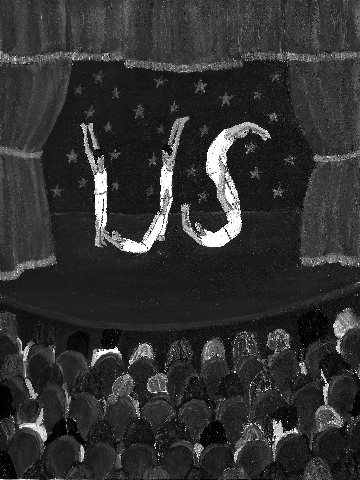
The Hudson Valley has been a cradle for many things, and among them are two forms of improvisational expression that serve as catalysts for growth and healing. Playback theatre and psychodrama—often confused with each other by the uninitiated—both evolved here, and each thrives locally and worldwide as well. Playback theatre and psychodrama both use improvisational action to create scenes, but they are quite distinct from each other. Some confusion is understandable in our region as some practitioners of playback also do psychodrama, and Boughton Place in Highland hosts monthly public sessions of both.
Key members of the founding troupe of artists who cocreated playback theatre, including Jonathan Fox, Jo Salas, and Judy Swallow, are Hudson Valley residents. “The idea of playback theatre emerged back in 1974,” Salas recalls, “when Jonathan Fox [her husband] first came up with the idea of telling real stories of real people. We were artists and believed in the unique power of experience—that something different and larger is created when you filter experience through the medium of art. We gathered a group of people to try this idea, and we experimented for a couple of years with how to actually do it. It was a collective exploration.” Salas emphasizes that, unlike psychodrama, a therapeutic technique, “Playback was not originally conceived as psychotherapy, and never has been framed as that in our view. But because playback is about personal story,” she adds, “it can be used by a therapist in a therapeutic context.”
PLAYBACK STEPS ONTO THE STAGE
“I was a theater artist when I thought of the idea,” Fox says of playback’s inception. “What interested me from my college years was oral tradition and the old stories that are told in performance—stories that are not just entertainment, but contain the ethical precepts of the people. Then I became interested in experimental theater, and was in the Peace Corps, spending a couple of years in Nepal, absorbing preindustrial culture. I learned many things there that were constructive for the community. I wanted to bring some of those things to modern day life. In playback, we’re artists who bring people’s stories to the stage, and the effect is to build community and to in some way provide a kind of community-based healing. We believe that whatever anybody chooses to tell—whether it’s about a special concern, a problem, or something as simple as a beautiful day—we can listen and have the artistry to bring out beauty and meaning for the teller and the audience.”
The Mid-Hudson Valley’s two playback groups, birthed from the original group, are Hudson River Playback Theatre in New Paltz, founded and directed by Jo Salas, and Community Playback Theatre, founded by Judy Swallow and offering public “First Friday” performances at Boughton Place. In addition, the Centre for Playback Theatre in New Paltz, of which Jonathan Fox is executive director, offers trainings and promotes playback theatre throughout the world.
LET’S WATCH
So what is a session of playback like? They vary, but typically there is a general flow that begins with a “conductor” (a member of the group) who welcomes people. Each actor tells a simple story of his or her life which the troupe depicts briefly. “That primes the pump a little,” says Swallow. “Then we ask for a few stories from the audience and the actors do ‘fluid sculptures’—short improvs that represents the feelings they heard expressed. That gives the audience a quick idea of what’s to come. Next, we usually ask people in the audience to greet someone new nearby, to get them used to talking about themselves. Then we usually have time for three or four longer stories, where a volunteer from the audience comes to the ‘teller’s’ seat by the stage, explains the story, and then picks the actors to be in the story. Then the actors create the scene by improv, along with improv lighting and music.”
At the end of a session, the conductor may ask the audience what kind of feelings are coming up, or what common threads link the stories of the evening. There isn’t a lot of psychoanalyzing about what happened. Still, says Swallow, “Sharing stories brings the deepest healing of our alienation.”
HUDSON VALLEY’S PLAYBACK DUO
Swallow started Community Playback Theatre almost 25 years ago, when the original company was going to disband. “I liked playback so much that I invited people who had taken playback classes or had come to the shows a lot to meet monthly, and then weekly,” she recounts. “A core of people emerged, and many of us have been meeting for 25 years. Our oldest member [of the acting group] is 81.We like the original company’s idea of being a people’s theater—that anybody who had the urge to be a playback actor could do it. So we do jams, where anybody can come for the day and participate, and see how they like it. We also do living-room playback, where you get together with friends and do it—people do charades, so why not do each others’ stories?” Besides hosting monthly public sessions at Boughton Place and a variety of other public and special interest sessions in our region, Swallow’s group offers ongoing classes at the Sanctuary in New Paltz. “It’s our gift to the community,” says Swallow, who encourages anybody to try it out.
Jo Salas’s group, Hudson River Playback Theatre (HRPT), has emphasized the community-healing power of playback. “From the beginning of playback we were aware that a great deal of what is unfair and unfortunate in society is the result of people not listening or understanding each other,” says Salas. “So there was a vision of using this as a community catalyst to develop tolerance and respect and justice. We wanted to create a forum for communication and integration of experience. You tell people what happened to you in the context of community dialog and ritual, and it has a healing function.” October’s public session is about climate change, where anyone can tell and watch stories about how it’s impacting their daily lives.
A prominent way Salas’ group is putting that into action is through the Immigrant Stories project, funded by the Dyson Foundation. “It’s a forum in which people who are not heard and not respected have a chance to tell their stories and gain a public voice. We do this because we feel the stories are very important, and offer immigrants a chance to see their experience embodied in theater. It has proved to be an amazing opportunity for people who are not immigrants to understand immigrants and why they came—the truth as opposed to the myth. Even those who have some degree of acceptance of the immigrant community are very often blown away by what they hear, which tremendously deepens their comprehension and compassion.” The first 20 performances (out of 55, and counting) have been transcribed into an illustrated book, Half of My Heart/La Mitad de Mi Corazón (available at www.hudsonriverplayback.org).
The other major project of HRPT is in schools, addressing bullying. “We’ve worked with about 20,000 kids,” says Salas, “going in with the goal of empowering kids to stand up for what’s right. It gives children an opportunity to tell and watch stories that have happened to them. Our work is based on extensive research about bullying that shows that the main opportunity to have an impact on it lies with kids who are the witnesses. We do some role-playing where they get to explore what they can do. They leave with some pretty specific tools.”
An international playback network has also developed, spreading to nearly 50 countries. “It’s been a very grassroots kind of movement,” says Fox. An international crowd signs up to learn from the School of Playback Theatre, founded in 1992 by Fox and Salas. “It’s fascinating who comes,” says Fox. “People who are involved in community development or communication see playback as a way to bring out voices.” He cites examples from this year’s just-completed five-week training: someone wanting to use playback to help a group of homeless people in Washington State, someone involved in bringing a lost tribe of Jews from India to Israel, and a town planner from Louisiana who is concerned about the fishermen who have been having a hard time since hurricane Katrina, and whose stories are not being told.
PSYCHODRAMA
Imagine a difficult scene from your past whose memory still lingers, leaving traces of wounding to this day. Perhaps it was a single event, like a painful breakup that ended not just that relationship but also trust in others. Or maybe it was a drawn-out experience, like a childhood of powerlessness and fear that now undermines building a fulfilling life. One-on-one psychotherapy that involves analyzing one’s history and expressing feelings can be inestimably helpful in uncovering these experiences and dismantling their power. Several therapists recognize, however, that additional healing modalities can deepen recovery and growth in ways that discussion cannot. One of these modalities is psychodrama.
Psychodrama creates scenes of key events or moments that have personal significance, so the event’s emotional or psychological impact can be explored therapeutically. A trained psychodramatist is the “director,” helping an individual recreate scenarios to glean insights and healing, or to “practice” future events. A key aspect of psychodrama, distinct from playback, is that the individual is part of the action in psychodrama, and “plays” not only herself or himself, but does role reversals to gain some clues to the perspective of others in the scene. Volunteers at the psychodrama session play the roles of others as needed.
Judy Swallow, who is trained in psychodrama as well as playback, sums up the difference in the two activities this way: “In psychodrama, the person is in the action, while in playback theatre, the teller watches. The ‘director’ in a psychodrama session, who is a trained professional, is very involved in how the process goes.” She likens a few-hour session of psychodrama to the process of creating a large oil painting, focusing in detail and depth on the story of a single individual (or a few), while playback is like making many little watercolors from the stories of several people.
The local chapter of the American Society for Group Psychotherapy and Psychodrama—which is the Hudson Valley Psychodrama Institute—offers a public demonstration session of psychodrama on the third Friday of most months at Boughton Place. The welcoming, country setting is perfect for letting go of fear and trusting the fascinating process that evolves. What’s more, Boughton Place houses the original round wooden stage built by psychodrama’s founder, Jacob Moreno.
“Psychodrama began in Vienna with Jacob Moreno, but he came here around 1925 and bought a sanitarium in Beacon and built the stage,” explains Rebecca Walters, a board-certified practitioner, educator, and trainer of psychodrama who has directed psychodrama sessions and taught classes for 30 years. The stage was moved to Boughton Place in 1936. “Moreno intentionally built the first step onto the stage to be twice as tall as the next two, because it was the first step people needed to take to do their work. Now psychodrama is used all over the world—there are 4,000 psychodramatists in Brazil alone.”
EXPLORING PAST, PRESENT, AND FUTURE
Psychodrama has diverse applications for awareness, growth, and healing. “A big part of it is finding creative and spontaneous ways to interact,” says Walters. “You can explore the here and now, and look at all the different parts of ourselves—the things we tell ourselves. That’s the psychotherapeutic part of it. Or we can redo things from the past—do and say the things we wish we had, and address some of the experiences in our past that are still impacting our present. For example, if I have someone who is having a hard time standing up for themselves, I’ll ask where in the past has this happened, and we put that scene up and give the person a chance to say what they didn’t, and create it another way. That frees them up.”
In addition, psychodrama can be used to imagine and rehearse for the future—a process called role rehearsal—such as an interview with a boss, making a marriage proposal, or facing a difficult event. Walters gives an example from a session she directed, in which a woman was going to a family holiday gathering. “The woman was in her sixties, and wanted it to go better this time than it usually did. So we set up the scene of the family gathering [with various people playing the family] and had her reverse roles with every member of the family. When she walked onto the stage as her sister, and saw herself through her sister’s eyes, she realized she wanted to find a more creative way of interacting with her.” Walters had the woman recreate a childhood family event, which helped work through issues impacting the family dynamic today.
Psychodrama has other applications outside of individual therapy. It has immense power in helping people to understand group scenarios and to practice situations. Psychodrama is helping to train hostage negotiators, aid trial lawyers in uncovering their clients’ stories, bolster college residence counselors’ skills, and more. An offshoot of psychodrama known as sociodrama explores social and political issues; a recent example of its application in Dutchess County, says Walters, is in helping kids who are reentering school after being in a psychiatric hospital. All the key people who would be involved create scenes together, so that each can explore different roles.
The Hudson Valley Psychodrama Institute trains therapists and counselors in psychodrama methods, leading toward national certification by the American Board of Examiners in Psychotherapy and Psychodrama. The institute’s classes also qualify as continuing education units for therapists, counselors, and others.
Improvising scenes from real life, whether through psychodrama or playback, touches everyone involved, often deeply. The popularity of both methods worldwide speaks of hope for a common, compassionate humanity. As Salas sums up about her 33 years of playback experience, “I’ve come to understand how important it is to listen. When people tell what happened to them in the context of community dialog and ritual, you understand the life of the community. I feel so enriched by the stories that we hear. Each one feels like an enormous privilege.”
RESOURCES
For more information about playback theater and psychodrama, and for a
listing of classes and events, contact:
Hudson River Playback Theatre: (845) 255-7716; www.hudsonriverplayback.org
Community Playback Theatre: (845) 255-7502; judyswallow@verizon.net
Centre for Playback Theatre: (845) 255-8163; www.playbackcentre.org
Hudson Valley Psychodrama Institute: (845) 255-7502, www.hvpi.net
This article appears in September 2008.


