








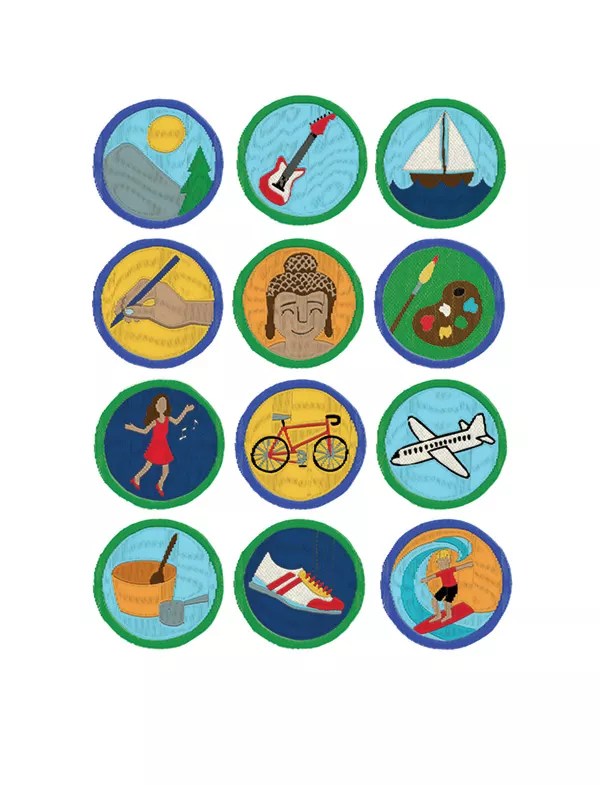
Beth Kempton wants you to love your life. She herself is very good at doing just that—at living her life like a great adventure. The British entrepreneur and mother of two has traveled from the Arctic to Antarctica to Africa, hosted her own TV show in Japan, and hobnobbed with international soccer stars. “Friends tell me, all these crazy things happen to you. You meet bizarre people, you’ve been to amazing places. They wonder where I get the money, but it’s not about privilege. It’s about my attitude to life. How one thing leads to another, making connections, being open, being brave,” says Kempton, who has also climbed high up the corporate ladder—only to tear it all down and reinvent herself. It was during this particular transformation that she created Do What You Love (DWYL), the name of her company as well as her signature online course designed to nudge people out of ruts, incite self-exploration, and effect the changes necessary to realize their fully blossomed selves.
As a new year emerges and a blank calendar beckons with possibility and potential, this carpe diem approach to life catches the attention of the change-maker that lives within us all. Most of us have heard that New Year’s resolutions never work, casting a shimmer of doubt and naïveté on our best efforts to blaze a new trail. Yet a host of resources exist to help us on our way, from live online courses like Kempton’s that connect people around the world (many of her students live in the UK, US, Canada, Australia, and New Zealand) to life coaches ready to be tapped for one-on-one sessions in person or by phone. They are available, they say, to help us listen deeply, to stir up our most secret desires and goals so we can perhaps make a shift in a fresh direction—hopefully, toward a truer version of ourselves.
Journeying Inward, with an Escort
Kempton knows how scary it can be to make an about-face with your life. “Just the words do what you love can sound intimidating,” she says. So her five-week DWYL course, with its mix of practical and right-brain exercises, gets you there in circuitous ways. “People [taking the course] can expect to ask themselves all kinds of questions that they’ve never asked themselves before, sometimes thinking, where is this going? There are so many different points of interest, of experience, of knowledge—things that bring you alive. The tools in the course help you make those connections. Your brain then does the work, the synapses fire, and it’s incredible the ideas that come up, that you’d never get to if you were thinking in a linear way.” Some of it involves remembering the way we used to be—where the creative spark has lived for us, whether it was in the garden or by the sea, or on a canvas or a blank page. Adds Kempton, “The quest for the what is sometimes the most interesting thing. You don’t know what your dream is? That’s a reason to be curious. That’s a reason to take yourself on adventures and go discover it.”
The outcomes vary wildly: After the course, Kempton has seen students get divorced, propose marriage, change jobs, start their own businesses, move to a different continent, become teachers of whatever it is that they love, or turn their hobby into a full-blown mortgage-paying career. One student was an IT consultant who nursed a dream of being a musician. “Through a simple time-budgeting exercise, he realized that if he negotiated Fridays off he could use that time in his recording studio with no pressure, because he was still earning good money, and get back to his music 20 percent of the week,” says Kempton. “He’s recorded his first album. Really simple solution, but it’s changed his life.” Another student was so limited by chronic back pain that she hardly left her house; during the course she remembered the sense of adventure she’d once had and started taking baby steps toward that again, driving to a beautiful place and just being there, even if she couldn’t walk very far. Now she’s building an online business so that she can get off sick leave and work from home.
“Many people get a lot out of the psychological side of the courses, how to be more brave and bold,” notes Kempton. That was the case for Ruth Husain, a stay-at-home mother from outside London who had taken five years away from the workforce to have children. “I had lost a lot of confidence since I stopped working, and lost my identity really, so I wanted to reconnect with myself and try to regain some courage and confidence,” she says. “I’m not exaggerating when I say [DWYL] has been like intensive therapy. It has enabled me to change my whole outlook on life. I have a few ideas for the future now that I am genuinely excited about. Even if they don’t take off, I’m not afraid of failing anymore.”
One aspect of DWYL is finding like-minded support: Each course has its own online community. This year, Kempton will be launching a membership site to make the social aspect even bigger. She has also added more courses with names like Make Art That Sells and Business Soul Sessions, on how to start a soulful business—some of which she teaches herself and others that she produces behind the scenes. In April, Kempton will publish a book, Freedom Seeker: Live More. Worry Less. Do What You Love(Hay House), available for preorder on Amazon. “We want to show that it’s okay to take your dreams seriously,” she says. Naysayers will sometimes ask, “Isn’t it selfish?” The guy who chooses to play music on Fridays—what about his wife? “But what we often discover is that the people who live with the person who’s going through this process get really inspired by association,” says Kempton. “They see this person coming alive, and they become curious. They start talking about how we can make changes together. Also, if you have a talent, you’re inspiring and helping people through the expression of your talent. Quite the opposite of being selfish, it’s an amazing way to express love in the world.”
A Revolution of the Spirit
There’s much to be said for a supportive network that will lift you up and ignite your spark. But for many people, it’s a one-on-one connection with a coach or mentor that fans a small passion into a flame. “You can certainly help someone lose weight or stop smoking or change a habit or reach goals. I do all that, but that’s not where the action is for me,” says David Basch, a strategic coach based in West Hurley. “What I hope to do is open the door to transformation in some manner. I’m not going to tell them what the door is—they have to discover it. Coaching is always about the client’s agenda. However, many people might come to coaching with a small agenda. Even if it’s getting a new job, which they consider to be big, I consider that a small agenda. What I’m interested in is them discovering who their best self is, so that the job reflects who they really are.”
Perhaps the biggest misconception about coaching is the idea that you’re going to get advice from your coach, or that your coach is going to put together some kind of blueprint for you. “That’s not what coaching is about,” says Marybeth Cale, a life coach based in Rhinebeck. “It’s designed to promote self-discovery for the client. The design of their lives moving forward is driven by them. The coach is making observations and providing support, accountability, and motivation. Coaching is really about becoming more mindful of what makes you feel alive, what makes you feel connected, joyful, and productive.”
Basch adds that successful coaching is the ability to ask powerful questions—a kind of drilling down that goes deeper into the person’s wants and dreams, which are sometimes hidden even from themselves. It is also a kind of deep listening, and a mirroring back of what you’re saying so you can see yourself. “When I’m working with somebody I’m really listening for what’s being said, for what’s not being said, for the unspoken—for the person behind the voice.”
When coaching works, people get empowered, and they arrive at places they could never have anticipated finding at the beginning of the process. Sandra Sellani, a former marketing executive based in Newport Beach, California, came to Basch with a gnawing feeling of discontent. A high-paying, all-consuming career, which she had built over nearly 30 years, was no longer working for her. “My values were not coinciding with the values of the company I was working for,” says Sellani. “So it created a kind of crisis for me. You want to feel like you’re living a life that’s in alignment.” In the process of working with Basch, she found validation to do something that seemed to defy logic: She left her very lucrative job and took a part-time consulting position that paid much less but gave her time to think, run on the beach, and just be. As far as she knew, she had taken the big step just by quitting her job—yet her true transformation would begin a few months later.
During her free time, punctuated by sessions on the phone with Basch, Sellani realized that she held a secret dream of becoming a vegan chef. She loved to cook, she was a vegan, and she loved animals. First she volunteered in the vegan community, creating recipes for an organization; then she enrolled in a culinary school focused on plant-based cooking. In April, she is coming out with a cookbook coauthored with her twin sister, The 40-Year-Old Vegan: 75 Recipes to Make You Cleaner, Leaner, and Greener in the Second Half of Life (Skyhorse Publishing). The amazing thing is that she never could have seen all this coming. “It was a total surprise,” Sellani says of her transformation. And it all happened during a fairly short period of time working with Basch. “He cuts to the chase very quickly and helps you come to a place where you would have likely come to on your own, but maybe 10 years later. He’s a catalyst and an accelerator.” She also knows that she couldn’t have done it without some periods of solitude and rumination. “Things bubble to the surface. You have to give yourself some silence to help things emerge in you, because you might not even know what they are.”
It all begins with listening to the small voice within that says something is not quite right, and resisting the urge to shut that voice out. “I think it’s one of the last great taboos, if you live in a privileged place like the Western world—saying that you’re not really happy in your life,” says Kempton. “We get caged, we build these lives that shut freedom out. But we can get out of that cage.”
This article appears in January 2017.


