








After a season of record prices at gas pumps, there is one phrase that is a common denominator of concern as the region faces the winter season—heating efficiency. Homeowners will be looking to meet their heating needs in the most cost-effective, comfortable, and environmentally conscious ways possible. More than ever, businesses, organizations and individuals throughout the Hudson Valley are instituting a variety of systems and techniques to see that this is done. Chronogram spoke to some of the local pioneers of these alternatives to garner their efficient home heating suggestions.
BIODIESEL: ANOTHER KIND OF TANK FULL
If you have an oil burner that is serviced yearly by a heating professional, it’s pretty simple to get started replacing a percentage of costly oil with biodiesel—potentially saving gallons of fossil fuel and a lot of money. Jerry Robock, a former oil company employee who is now the president of Community BioFuels in Westchester, says that everything depends on the furnace you have, though a technician will usually only have to change the nozzle size and increase the pump pressure to accommodate the difference in viscosity to begin using biodiesel. There are, however, other considerations that are best discussed with a fuel service provider or biofuel expert.
Biodiesel, a renewable fuel made from new or used natural oils, acts as a solvent—so homeowners will want to start with around 5 to 20 percent biofuel (which would be referred to as B5 or B20), and increase the ratio of biofuel to traditional fuel from there, Robock says. This will gradually clean out the tank and help avoid clogs. “When you first use biodiesel in a car or furnace it will clean the system out by attracting and dissolving any sediment that might be in your tank,” he says. “So the first year you need to make sure you get an extra filter cause it will get clogged with all the stuff that’s cleaning your system out. The good news is that your system is now optimized, but you have to be aware initially and take care to make sure that you don’t have any problems.”
Robock also says that outdoor tanks can cause issues. “If you have an outdoor tank and you go to a higher percentage of biodiesel your fuel may gel, and you won’t have fuel,” he says. “So there’s things you have to be aware of if you want to switch.” Robock uses an in-ground tank, which regulates the temperature of the oils and prevents gelling. Outdoor tanks also carry the possibility of sucking in moist air that can lead to algae or fungus growth in the fuel, which will clog filters and have to be remedied by a technician.
Biodiesel offers an array of benefits, from its low toxicity to its domestic production, but if it’s purchased from a home heating oil company, it can often cost more than traditional fuel alone. “My recommendation is for people to call home heating oil and ask if they offer bioheat, and if not ask why not,” he says. “Unfortunately the price of bioheat is almost always more. Especially now with $4 a gallon prices—it’s already astronomical, why pay an extra 10 cents? Most heating companies aren’t offering it because there’s not a market for it.”
The savings come in when individuals produce their own biodiesel at home, like Robock, or join organizations like the Hudson Valley Biodiesel Cooperative, where he is also involved. Both options provide an alternative to reliance on the home heating companies for biofuel. Members of the coop (who pay a one-time $50 membership fee and log hours working for the coop—picking up used vegetable oil from restaurants, running the biodiesel processor, and distilling the biofuel—to earn the right to purchase the biofuel) of the coop can currently purchase a gallon of biodiesel for about $2—a significant savings if used to replace portions of traditional heating oil. While 100 percent biodiesel would certainly run in a furnace, Robock says, “Unfortunately no one is selling 100 percent biodiesel in bulk. It would be very hard to find and very expensive to buy.”
HEAT PUMPS: GEOTHERMAL AND AIR SOURCE
Paul Tesoro, the director of corporate communications for Central Hudson Gas & Electric, says that geothermal heating is gaining widespread acceptance and has become a viable industry. Geothermal heat pumps are installed underground to absorb energy from the sun that’s stored in the earth. “[The pump] extracts cool air out of the earth to air-condition a home in summer and the system reverses to heat the same space during cold weather,” says Tesoro. “No fuel is burned, but it does operate electrically, so there is some impact at the power plant. For the individual homeowner there is no environmental impact at the home. It’s a very efficient, very environmentally preferable option.”
Because it involves significant excavation to install, Tesoro says geothermal technology is impractical for existing structures and suburban homes that will be built on small lots. He says that homeowners who cannot use geothermal can get the next best thing by installing an air source heat pump. As opposed to geothermal technology, air source heat pumps draw the heat from the surrounding air, instead of the heat energy stored in the ground.
“Both types of heat pump operate using the same kind of heat-exchange technology that makes your refrigerator operate, or a window air conditioner for that matter, by the circulation of a refrigerant chemical through tubes or coils,” Tesoro says. “In a geothermal system, that circulation is happening belowground, and the circulation is happening in an environment of constant ground or water temperatures. In an air source heat pump, that circulation takes place outside the house, in the system’s condenser unit—which looks like a big metal box, usually right next to the home’s foundation.” The air source heat pump system is similar to the workings of a refrigerator, where that circulation takes place at the very bottom of the unit and you can feel warm air being blown out from under the fridge, he adds. “That heat has been displaced from inside through the same basic heat-exchange technology.”
By using the heat pump as a secondary heating source, homeowners can save money by avoiding the burning of oil until below freezing. “Think how much oil you save by only burning oil in a cold snap,” Tesoro says. “It’s very easy to install in any home that has central air-conditioning and has ducts.” The pumps need ducts and will not work in a home that with baseboards or radiators.
RADIANT HEATING: THE FLOW UNDERTOE
Radiant heating is a distribution system that can work in tandem with most energy sources and help lower energy consumption and cut costs in the long run. “Radiant floor heating is a heat delivery or distribution system that delivers heat to the home by heating the entire floor surface,” says John Abularrage, owner of Stone Ridge’s Advanced Radiant Design. “By heating the entire floor surface you have warm feet, for one thing, and no matter where you move in the space you have direct exposure to very even heat. The heat transfer is much like the sun’s, and you can be more comfortable at lower temperatures.”
Radiant heat is installed using a system of plastic tubing called PEX (cross-linked polyethylene), which is embedded into concrete slabs or on framed floors in an underlayment that goes directly under the finished floor. Heated water flows through the PEX tubing, warming the floor. Radiant heat can be used with a variety of flooring materials, including wood and carpet, with some minor limitations. For example, certain types of carpet padding would be avoided because they are too insulating and would inhibit the flow of heat.
Radiant heat is more efficent and comfortable than baseboard or forced air heat because it heats directly—Abularrage says general industry statistics show that radiant heating is 20 percent more efficient than baseboards and up to 40 percent more efficient than forced air. The lower temperatures associated with this system also take stress off of heating systems and can save in oil and related costs.
“It’s a very low-temperature delivery system,” Abularrage says. “You can heat a home with certain types of radiant floor heat with water as low as 100 degrees, where the conventional system would require water temperatures of 160 to 180 degrees. Those lower water temperatures can increase the efficiency of the boiler system, depending on what your boiler system is, by as much as 10 percent. For geothermal systems, which are quite popular now, using the low temperature distribution system of radiant floor heat can increase the efficiency of a geothermal heat pump by 50 percent, which is significant.”
Though radiant heat is a pricey option when compared to baseboard and forced air, Abularrage reiterates that it’s the most effective, and will pay for itself in savings over time. It works best with new construction, but existing buildings can be retrofitted, especially if floors can be easily accessed from below.
PELLET STOVES: NOT BURNING THE MIDNIGHT OIL
The numbers speak for themselves—a 50 percent savings on heating costs for homeowners that use pellet stoves, says Deidra Darsa, a spokeswoman for the Hearth, Patio and Barbeque Association (HPBA), based in Arlington, Virginia.
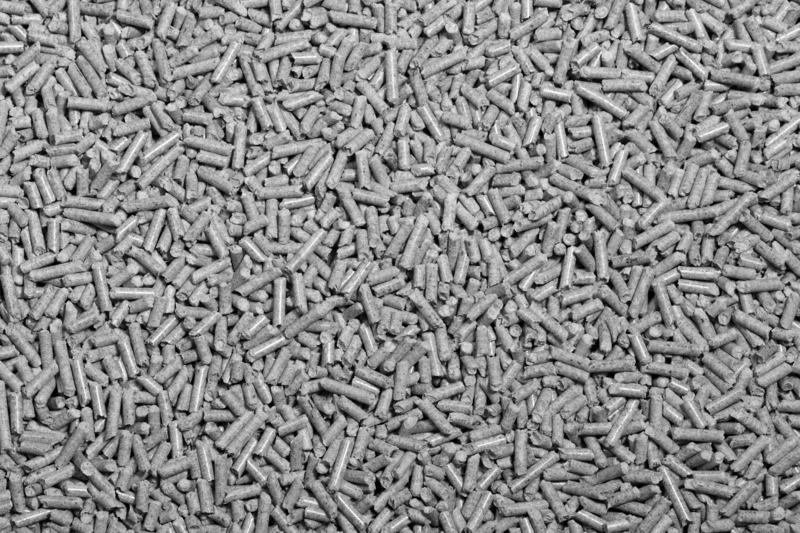
Pellet stoves are fueled by natural materials that pose little threat to the environment. “Pellet fuel is made from sawdust or forest waste and has no additives, only a natural binder, lignin, that is found in the wood,” Darsa says. “Some stoves are able to burn corn and cherry pits as well.”
She says the cost of heating a home during the heating season would require about three tons of pellets, a total cost of $750 to $1,000. “Consider that each year a homeowner would save over 50 percent using pellets compared to other heating. The US Energy Information Administration reports that during the 2008-09 heating season fuel oil will jump 45 percent from last year and the typical consumer may spend $2,858 during the heating season.”
Another benefit is that pellet stoves are relatively low maintenance. Darsa says the stoves burn very clean, only need to be filled, on average, once a day, and require emptying of the ash pan just once a week. “They are easily installed and can be vented either vertically or horizontally,” she says. “They do require electricity but only use 573 watts at startup for the igniter and then drop to 200 watts for the blower during operation.”
According to the HPBA, the stoves are growing in popularity—during the first quarter of 2008 compared to the first quarter of 2007, the sale of pellet stoves jumped 54 percent.
Even if you aren’t looking for a heating overhaul, there are small things you can do to ensure you’re getting the most for your money. Tesoro reminds that the most efficient home is a well insulated home, and that homeowners should be sure to schedule professional maintenance and tune-ups of heating equipment to ensure optimal performance. He also warns that as heating prices increase, it’s never worth the risk to bring outdoor equipment inside for heating purposes. “We understand the need to keep warm but please keep safety in mind,” Tesoro says. “Don’t use devices inside that home that are not meant for indoor use. Saving money and saving energy are great, but saving a life is much more important.”
RESOURCES
Advanced Radiant Design
96 Vly Atwood Road, Stone Ridge
(845) 687-0044;
www.radiant-design.com
Hudson Valley Biodiesel Coop
150 Cottekill Road, Cottekill
www.communitybiofuels.com
Central Hudson Gas & Electric
284 South Avenue, Poughkeepsie
(845) 542-2700;
www.centralhudson.com
Hearth, Patio, and Barbeque Association
1901 N. Moore St., Arlington, VA
(703) 522-0086; www.hpba.org
This article appears in September 2008.


