








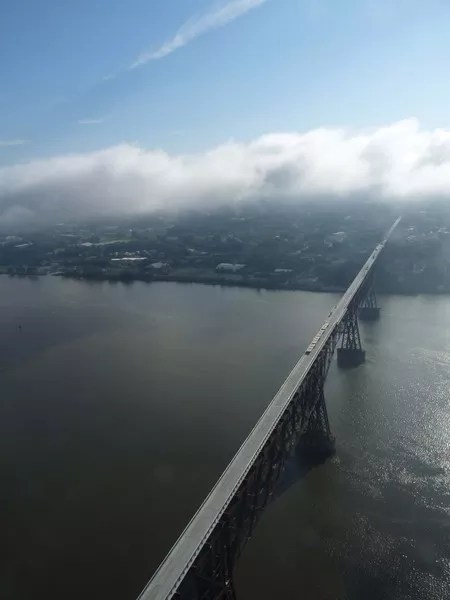
For nearly a quarter of a century after it caught fire in 1974, the abandoned Poughkeepsie-Highland Railroad Bridge stood silently, a once proud emblem of the Industrial Revolution and manufacturing prosperity in the Hudson Valley. Considered a technological marvel when it opened in 1888, it was the longest bridge in the world and the only bridge across the Hudson River between New York and Albany until 1924. As such, the “Great Connector” linked local farm produce and Pennsylvania coal with New England cities and factories. Although primarily used for freight, the bridge also conveyed trolleys and passenger cars during its early years, including the elegant Federal Express train from Boston to Washington, DC. During World War II, as many as 3,500 rail cars per day traversed the bridge, transporting soldiers and war materials to eastern seaports. Fittingly, after a complete makeover, the bridge will be reopened this month as the longest pedestrian/bicycle bridge in the world and a symbol of revitalization within the region as well as America’s 21st-century commitment to environmental and historical preservation.
Notwithstanding its age and 25 years of neglect, the bridge remains structurally sound, a testament to the skill of its designers, Charles Macdonald and Thomas Curtis Clarke. It consists of three cantilever spans interspersed with two truss spans, supported by steel towers and four 10-story, concrete-filled timber caissons resting in nearly 140 feet of water. Stretching from anchorage pier to anchorage pier, the bridge is 3,094 feet long. The 525-foot cantilever spans remain the longest and heaviest in the world, providing 160 feet of clearance above the river, while the bridge surface soars to a dizzying height of 212 feet. The original construction was completed by the Union Bridge Company of New York under the supervision of Chief Engineer John F. O’Rourke at a cost of $3.6 million.
Following World War II, railroad traffic over the bridge progressively diminished, thanks to the rise of airfreight, federal highway subsidization, and the consolidation and rerouting of rail traffic to the modern railroad yard in Selkirk, seven miles south of Albany. After the fire of May 8, 1974, burned railroad ties, twisted track, warped steel girders, and popped rivets, the bridge was deserted. While preservationists struggled to raise money for proposed grandiose schemes that included constructing shops, restaurants, condo, hotels, docks with glass-walled elevators, and even a bungee-jumping platform, the bridge appeared fated for continued gradual decline and demolition, despite being added to the National Historic Register in 1979.
In 1992 a grassroots coalition, Walkway Over the Hudson, became incorporated as a not-for-profit organization for the avowed purpose of preserving the bridge by converting it to a linear park for pedestrians and bicyclists and providing for its ongoing stewardship. Ironically, these goals belatedly fulfill the mandates of two state bills passed in 1891 and 1893 to open the bridge to pedestrian traffic (a judicial ruling in 1920 declined to implement this requirement, citing legal and safety issues). Although Walkway Over the Hudson assumed control of the bridge in 1995, it was not until 2007, when the organization secured a $2.1 million gift from the Dyson Foundation, that sustained momentum was created. Subsequent donations from public and private sources including the State of New York and Scenic Hudson raised more than 70 percent of the total estimated $38.8 million cost of the project by April 2009, and by July 23 of this year construction had been 75 percent completed.
Several New York construction firms were engaged to complete the renovation. Bergmann Associates Consulting of Albany executed the overall design, under the direction of its project manager, Peter M. Melewski. Environmental Remediation Services, from Schenectady, was responsible for the removal of the old bridge deck, rails, and ties, and the Fort Miller Company of Schuylerville manufactured the 973 concrete panels, some weighing as much as 18 tons, that were installed by Harrison and Burrowes Bridge Construction of Glenmont. The completed walkway is 25 feet wide, with separate lanes for walkers, bicyclists, and rollerbladers. Designed for year-round use, the walkway is handicapped accessible and equipped with galvanized-steel safety railings, lighting, security cameras, emergency phones, and three viewing stations that encompass the entire width of the original rail bridge. Picnic centers at both ends, an interpretative visitor center and maintenance building, and access elevators are also planned.
The linear park falls under the jurisdiction of the New York State Office of Parks, Recreation, and Historic Preservation. It extends from Haviland Road and the adjacent rail trail in Lloyd to Washington Street in Poughkeepsie, and will connect with existing and future rail trails and riverfront parks, including: the Delaware & Hudson Canal Heritage Corridor (35 miles); Wallkill Valley Rail Trail (12 miles); Ontario & Western Rail Trail (24 miles) in Ulster County; the Hudson Valley Rail Trail (2.5 miles); and Dutchess Rail Trail (12 miles) in Dutchess County. The rich history, extraordinary views, and fresh breezes are expected to draw over 250,000 visitors per year, generate $14.6 million of direct spending, and $1.3 million in new local, county, and state tax revenues, although access to the bridge will be free. Local historian Carleton Mabee, the author of Bridging the Hudson: The Poughkeepsie Railroad Bridge and Its Connecting Rail Lines (2001, Purple Mountain Press), aptly concludes, “If visitors savor the rich past of the river and bridge, if they exult in the vast panorama of boats, trains, and distant misty mountains, the bridge might rouse the public’s imagination even more than it did when trains passed over it night and day, carrying the wealth of the continent.”
The grand opening of the Walkway is scheduled for the weekend of October 2, 3, and 4, part of the Hudson Quadricentennial. Events will include an illumination of the Walkway on Friday evening, a Walking on Air parade on Saturday afternoon organized by celebration artists Jeanne Fleming, theatrical and circus performances on Saturday evening, and a 5K run on Sunday morning. For complete information on the Walkway Over the Hudson and the weekend of opening events: www.walkway.org
This article appears in October 2009.


