









It’s around 4 o’clock on a sunny May afternoon, the weather reminiscent of a hot summer’s day. The grass outside is growing so fast you can almost hear it. But the grass inside is just beginning to sprout, rather quietly if not for the humming of industrial-sized fans meant to prevent stagnant air.
Sibby Hanson, a 27-year-old botanist and farmer, is grinning after inspecting 1,250 germinating cannabis seeds in a garage on Claverack Creek Farm, just a five-minute drive from Hudson. Hanson’s excited because the seeds, his plant children, are beginning to develop a green stem, about the size of a fingernail. Soon, Hanson will start to plant the sprouts outside, and after five months of sun and water, the tiny stems can grow some 12 feet into a mature cannabis plant.
Moke (pronounced like toke) Mokotoff, Hanson’s 72-year-old boss and owner of the farm enters the garage. He’s an art dealer who specializes in ancient Buddhist textiles with a spiritual reverence for the cannabis plant. “It’s the first medicine,” Mokotoff says in a sort-of raspy low-baritone murmur. Hanson agrees wholeheartedly. “There’s a gravitational pull around cannabis that brings people together,” he responds. Their glances are special, as if they know their work is serving a higher purpose.
Mokotoff walks inside the garage. He brushes his hand along his eyebrow acclimating to the indoor light. He looks around, and then pushes a plastic entryway open to take a turn at monitoring the seedlings, purposely confined to a curtained growth space within the garage, as if the small children in the chronic crib need tending.
Mokotoff met Hanson when the young botanist applied to work at the farm through a job listing on Indeed. They connected quite instantly, and now Hanson is living on the farm to monitor and oversee the cannabis harvest, among the first farms to grow cannabis for recreational use in the state. They’re waiting for the ideal moment to transfer the seeds into the ground outside.
Listening to Farmers and Nature
Claverack Creek Farm is one of the 52 New York hemp farms that were approved in April to legally cultivate cannabis. Hemp growers, bogged down by a saturated CBD market where the price for a pound of hemp biomass dropped from $40 to $10, have an opportunity to spearhead New York’s first adult-use marijuana grow this summer, supplying the recreational market, which is slated to launch later this year.
“We couldn’t compete in the commodity market of CBD,” says Melany Dobson, co-founder and CEO of Hudson Hemp, a women-owned regenerative plant medicine business operating in Hudson. She has no plans at the moment to continue growing hemp and is looking toward the future. “The transition from the hemp market to the THC market is a very natural progression, it is very progressive and is on the forefront of crafting a sustainable cannabis market.”

Her company was also one of the 52 first-round hemp farms to obtain a conditional license to grow adult-use cannabis in the state. (As of June 1, 162 cultivator licenses have been granted, with further applications being approved on a rolling basis). And, while there are many horticultural similarities between hemp and marijuana, there is a lot of uncertainty around how cannabis will perform in New York’s humid continental climate zone. “It’s really important to note that cannabis has not been cultivated outdoors at scale in New York,” says Dobson. “The state is rolling out its recreational cannabis program by listening to farmers and to nature.”
“I think that next year farmers will pump out more high-quality flower because there’s a bit of a learning curve that needs to take place,” says Brittany Carbone, co-founder and CEO of Tonic, a line of CBD wellness products, and Tricolla Farms, an event space where their cannabis will be grown in Berkshire, a town 30 minutes south of Ithaca.
Numerous Unknowns
Nonetheless, unpredictability and learning are tethered to the state’s ongoing roll-out of legal marijuana. It is unknown exactly how much cannabis will be harvested at the end of the growing season, or how much it will sell for, or even to whom it will be sold. What is known, however, is that navigating uncertainty is not a deterrent, but rather an integral component in cultivating a compassionate working relationship between farmers and state government. “The Office of Cannabis Management is proud of the work we’re doing to prioritize New York’s small farmers and set them up as the first adult-use cannabis farmers in the state,” says Aaron Ghitelman, deputy director of communications for the state’s Office of Cannabis Management (OCM).
A legal market for adult-use cannabis in the state is uncharted territory for everyone involved. With large corporations vying for a majority share of the cannabis industry in states like California and New Jersey, the Office of Cannabis Management in New York is carefully trying to ensure that small-scale farmers are guiding the state’s policy. “The OCM knew that in order for us to have any shot at being successful and have inventory to fill the shelves, they were going to have to get farmers legally growing quickly,” says Phil Spinelli, farmer and owner of Nightshade Farms in the Rensselaerville town of Medusa. He was a part of New York’s first cohort of farmers who were officially given the go-ahead to start growing cannabis.
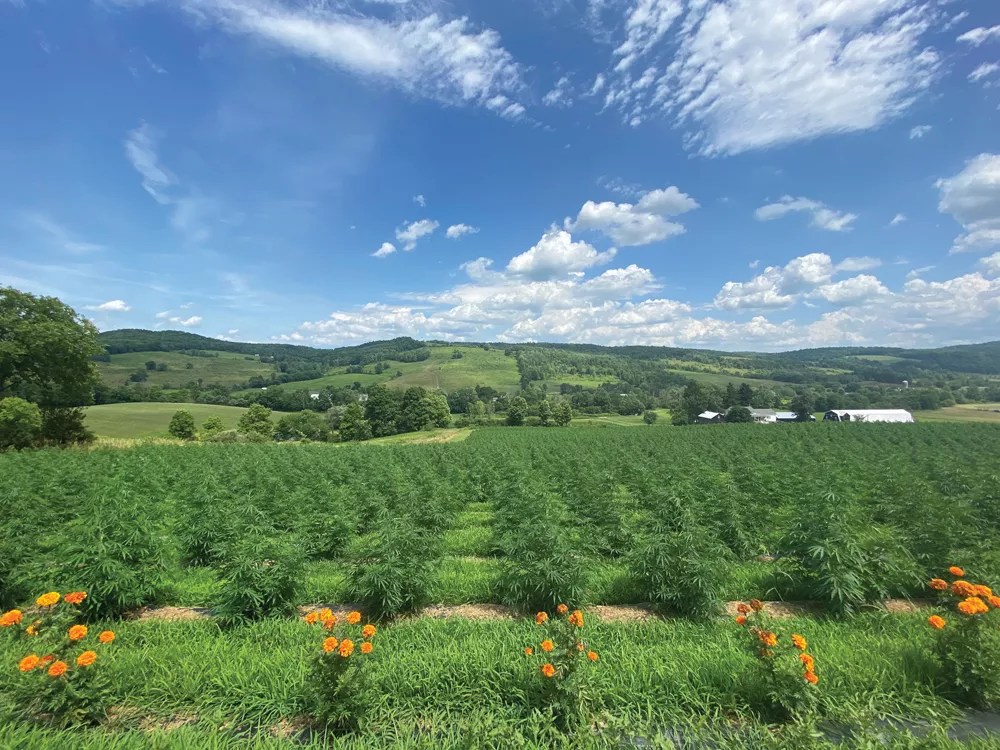
The process of getting farmers to grow marijuana legally happened fast. In February, Governor Kathy Hochul signed the Conditional Cannabis Cultivation Bill providing an opportunity for hemp farmers to grow cannabis. Three weeks later, the state started accepting applications for the adult-use cannabis cultivator licenses. In March, 150 applications were submitted from hemp farms across the state.
“And then, you know, we had to put plants in the ground by late May, early June in most cases, so it moved fast,” Carbone says. She is also on the board of the New York Cannabis Growers and Processors Association, an industry group that represents farmers, processors, and other cannabis businesses. Carbone does not plan to continue growing hemp out of fear of cross-pollination. She also will not be growing cannabis indoors this year, though she plans to set up a greenhouse for the next growing season.
“It’s going to prove difficult to debunk the stigma around outdoor flower in terms of quality right away,” Carbone says. “This isn’t necessarily something I would say the state did the wrong way, it’s just the realities of the timelines that we’ve been working with and, you know, honestly, I’d rather have the opportunity to be able to grow this season than to not have that opportunity.”
In many ways, the state sped up the conditional cultivator license process as a way to allow farmers to make a trial run so seeds could be planted at the start of New York’s growing season, to try and ensure enough product would be on dispensary shelves before the end of the year. Spinelli remembers hearing the news that the state was going to allow hemp farmers to grow the initial stock of legal New York cannabis on the radio. “I remember sort of scoffing and being like yeah, right,” he says. “It felt so anti-corporate, like how are the medical marijuana companies going to let this slide?”
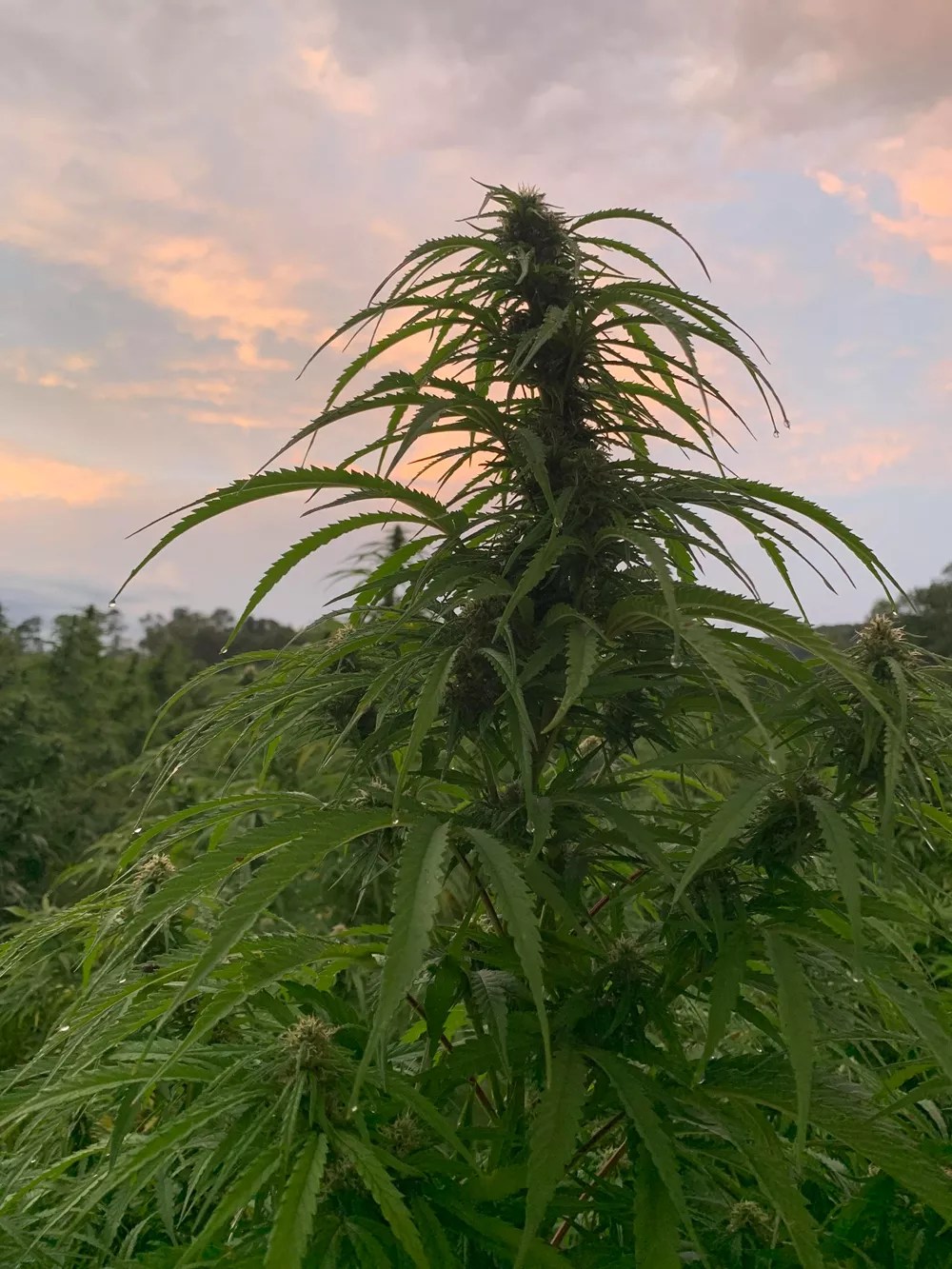
For Spinelli, acquiring the conditional adult-use cultivator license is a chance to be a part of creating a safe product for consumers in a legal market. “Maybe the spirit of this market is meant for more disadvantaged farms like us, with a husband and wife pulling 16 hour days,” he says. “Maybe it is really not for those stomping their feet and holding their breath about the canopy limits.”
With a conditional adult-use cannabis cultivation license, cultivators are restricted to one acre of outdoor flowering canopy or 25,000 square feet in an indoor greenhouse. These farmers can manufacture and distribute cannabis flower products without an adult-use processor or distributor license until June 1, 2023. They can also divide outdoor and greenhouse grows with a maximum canopy of 30,000 square feet if the indoor grow stays under 20,000 square feet. There is still uncertainty where the farmers will be selling their harvest, as they cannot sell directly to consumers. As a part of the state’s Seeding Opportunity Initiative, announced by Governor Hochul earlier this year, legacy equity-entrepreneurs, meaning people most uprooted by the disproportionate enforcement of cannabis prohibition, will be the first to make adult-use retail cannabis sales in New York with marijuana grown by New York farmers.
A Way of Life
Every morning, as the weather finds a consistent warmth, Spinelli checks on his seedlings—hundreds of young sprouts developing from a plant embryo derived from the cannabis seed.
He is apprehensive about planting the baby sprouts in the soil prematurely. “We have a unique microclimate here and it can be fairly chilly even after the frost date over Memorial Day weekend.” Spinelli is aiming to plant the sprouts in the ground in early June. He speaks about the process of farming with great admiration and respect. “It’s a way of life. I’m not in this to get rich.”
Spinelli, like many hemp farmers, is reluctant to divulge where he obtained his cannabis seeds. It was important for farmers to find seeds that would thrive in the Northeast, but where exactly the seeds had to come from was a gray area, undefined in the law. Depending on how the seeds were acquired, hemp farmers have concerns about interstate transportation, regarding how legal it is for the seed to cross state lines where cannabis is illegal. New York is approaching this by actively ignoring the fact that hemp farmers have to procure cannabis seeds from out-of-state. They are turning a blind eye to this particular detail, because there is seemingly no way around it. For hemp farmers to obtain cannabis seeds legally would mean they are coming from growers in-state, and that market doesn’t exist yet.
Spinelli, and the other farmers I spoke to for this piece stated that they obtained their seeds legally. “What we are doing is crossing that gray area,” says Mokotoff of Claverack Creek Farm. Once it was permissible for his farm to start cultivating cannabis, he reached out to Ethos Genetics in Colorado and Mass Medical Strains in Massachusetts, well known seed distributors, to obtain seeds needed to start the harvest.
Mokotoff and Hanson question how the additional 36 cannabis cultivation licenses given to farms at the beginning of May will be able to grow their harvest fast enough.
“‘Can we do it in time?’ is the big question, because we’re the first to do it,” says Hanson. He anticipates his outdoor grow will yield roughly 700 pounds of cannabis by the end of the season and that around 25 percent of that will be considered “high-quality” flower. Usually, this is the part of the plant that has access to the most sun. It has a stronger aroma, and potency and also has “bag appeal,” meaning it has a variety of colors and crystal-like features that allure customers.
It is the consensus among these farmers that the yield from the first round of cannabis cultivation will produce a systemic undersupply. Testing labs have yet to be established. And logistics regarding how the legacy operator mentorship program will be established are not entirely clear.
“There’s been a lack of clear guidance on a few key points, from the track and trace system to details on the security standards,” Carbone says. She believes that the New York market will see good cannabis products coming out this year, “but maybe not enough of the good products that we would like to see.”
Dobson believes that hemp farmers, at the helm of the state’s rollout of legal cannabis, are a part of a multi-faceted movement. One that is trying to ensure high quality marijuana products are coming from ethical farms with an overarching ethos intent on revising how the state has previously treated legacy cannabis operators. “Weaponizing the plant is something that we’re fighting against every day, because ultimately the War on Drugs is a war on people,” says Dobson. “And we fully acknowledge that and are here to fight the good fight.”
Spinelli is excited to work with the OCM and speaks for many hemp farmers when he says, “As a New Yorker, it’s like, wow, look at this, the government can actually function and stay true to the spirit of the plant.”
This article appears in June 2022.



Cannabis is like wheat: It adapts to the climate. You just have to identify the most promising plants and save their seed. Hemp is monochromozonal so cultivation has a major influence on the plant as to whether fiber or seed is emphasized.
This should be legal everywhere. Seed is nutritious and it absorbs CO2 like a sponge.