








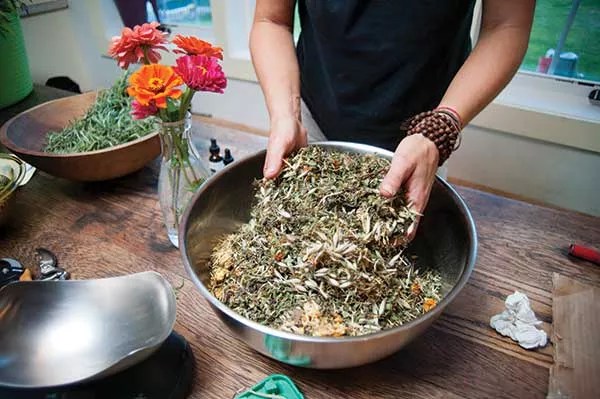
Health care has been much in the news these last few years, and preventative care understandably looms larger in the landscape. Helping people stay well is in everybody’s best interest. On three acres behind their spacious Victorian house in Germantown, Dana and Michael Eudy are hard at work building a medicinal herb farm into a prosperous business. Field Apothecary, in its second year, offers a resource for those interested in using locally grown plants to maintain wellness.
Both from Texas, by way of Brooklyn, the couple came to their love of herbs over the course of several years. For Dana, it was childbirth that sparked the interest. For Michael, a year spent in Italy earning an MFA in painting was his turning point: “We had never tasted food like they have there. All the food at the markets was from local farmers.” Eyes thus opened, Dana began taking classes in homeopathy and naturopathy while Michael stayed home with their two children, working part time. Then he took an eight-month intensive course that she initially planned to do, since he worried about her workload. “I started off just being the supportive husband, and then I fell down the rabbit hole too.”
Dana is the more mystically inclined, speaking frequently about the plants’ energies, while Michael approaches them with a cook’s (or bartender’s) experimental curiosity. It appears to be a potent pairing; they frequently finish each other’s sentences and their enthusiasm is evident and contagious. “We have lost our understanding of plant-based preventative medicine,” Michael says, describing a health-care pyramid analogous to the food pyramid we all know. “Emergency and hospital care is at the top, with specialists below, then your family doctor, then holistic care below that and grassroots care at the bottom.” Like the food pyramid, the things at the top should be consumed in small amounts. “If we can treat our fevers, coughs, and some of our mental health at home, we take a huge amount of demand off of the overburdened health-care system.” Since the Eudys are not certified to prescribe anything, Michael says, “when people come to us with specific problems, the best we can do is say, ‘These are herbs that have traditionally been used.'”
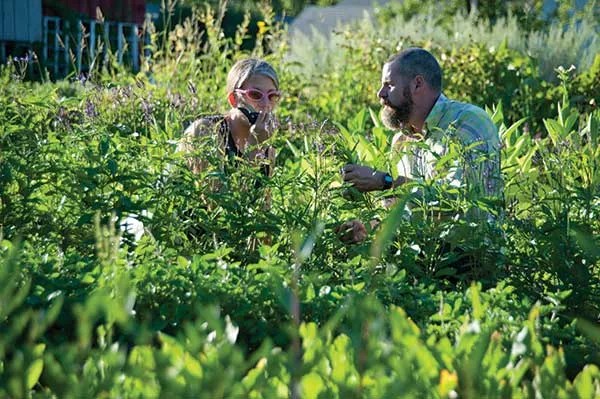
Walking through the neatly ordered garden, with well-weeded beds separated by mulch or mown grass, Dana expounds on the value of medicinal plants. “We evolved from the plants. They are our ancestors. They evolved these immune systems that absorb every toxin and pathogen in the environment and develop compounds to fight them.” Holding up a mint leaf, Michael continues. “We have spent millions of years evolving so we can extract nutrients from plants. There are probably 2,000 compounds in this leaf. Modern medicine tries to isolate between one and five of them and standardize the dosage. Nobody knows how all of them function together.”
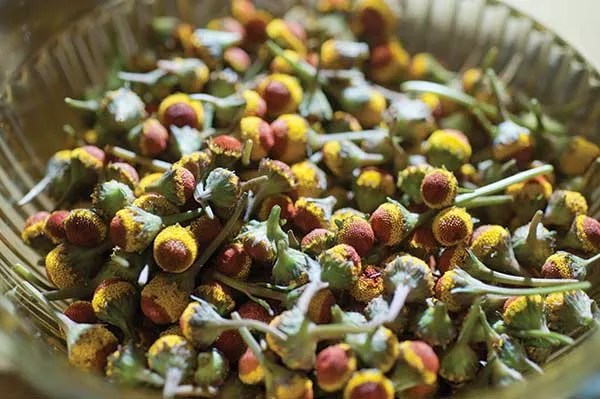
An herbal CSA forms the center of their business. Last year 30 members received one large delivery in late September: tinctures, syrups, dried herbs, salves, salts, and “fire vinegar,” macerated with garlic, onion, horseradish, and cayenne. They hope to expand the CSA to 60 members and four seasonal deliveries by next year. They also have a truck, which they are renovating into a food truck of sorts and which they hope to use as a combination mobile pharmacy and base of operations for the “pharm-to-table dinners” they are planning with a local chef. They also offer classes in ayurvedic medicine and growing and using medicinal plants at home. “Spilanthes is a great teaching aid,” Dana says, proffering a tight yellow bud for tasting. Initially citric acid-sour, the sensation quickly expands to a tear-inducing, almost wincing intensity, accompanied by copious salivation and a numbing heat not unlike Sichuan peppercorns. “We use it in our mouthwash.”
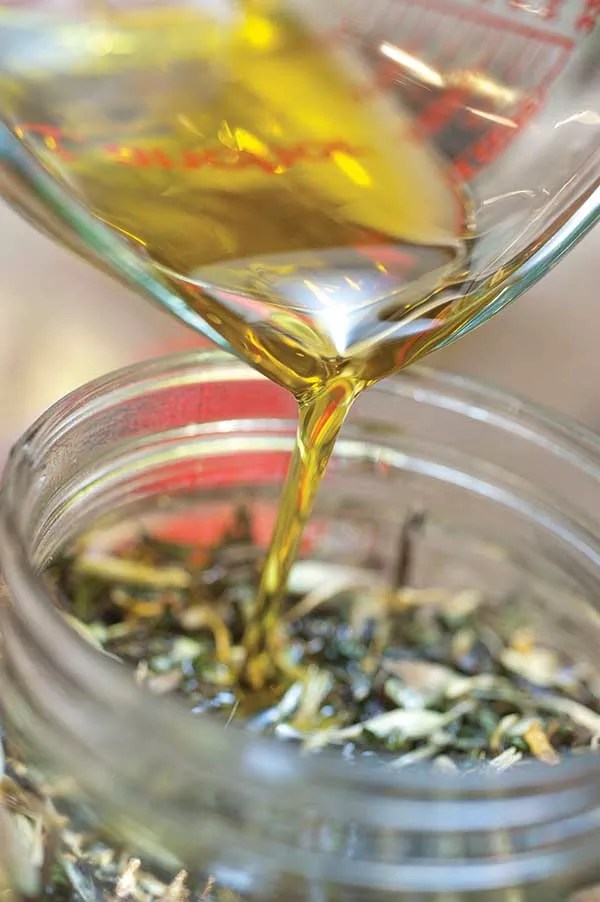
Back in the house, preparing a lunch of rice with tarragon pesto and sorrel soup (with lemon balm added to enhance the lemony tang and some kale to keep the color green since sorrel browns quickly) blended with chicken stock, Michael apologizes unnecessarily for his improvisational method in the kitchen: “I’ve never actually made this exact thing before.” The result is bright yet hearty, with the lemony tang of sorrel burnishing the sturdy stock, and the pesto on rice, simple food to be sure, nonetheless commands attention, especially for a diner who was in the field when the herbs were cut. Knowing their provenance, having seen and smelled and nibbled them outside, one becomes more receptive to and appreciative of their complexity and benefits.
That intentionality, the awareness and presence during harvest, cooking, and eating, is a big part of what the couple hopes to convey to their customers and students. “Fast food is always the same,” Michael says. “But handmade food is unique, and beautiful. We use all our senses to experience it. Time slows down when you focus on an aesthetic experience—something happens that can be deeper, even healing.” Their goal is to change herbs’ status in our minds from something we add a pinch of to something we feature more prominently as an ingredient. While teas and tinctures allow for larger doses (it takes a fair amount of plant to make a dried teaspoonful, after all) eating fresh leaves does give your body everything they contain, not just the water (tea) or alcohol (tincture) soluble compounds.
Those eager to begin their education on the subject of healing plants should buy a copy of Foraging & Feasting: A Field Guide and Wild Food Cookbook (Botanical Arts, 2013) by renowned local expert Dina Falconi. The first half is a guide to common wild edibles, beautifully illustrated by Wendy Hollender, and the second part is a cookbook, full of recipes not just for the plants covered in the book but also master techniques for beans, grains, desserts, and more. You will recognize most of the plants’ pictures from your yard; the book provides information and inspiration you can use right away to broaden and deepen your culinary rapport with the plant kingdom, increasing your health and pleasure simultaneously.
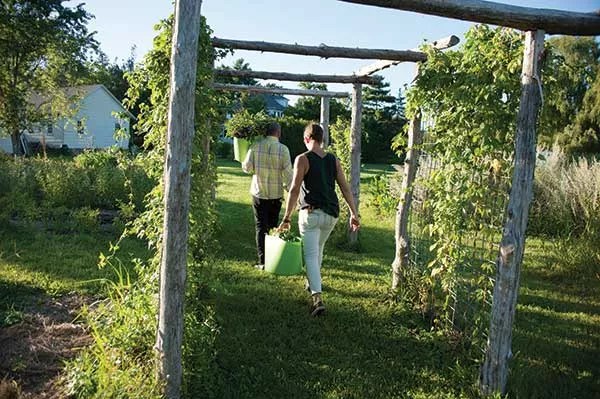
The Eudys own a popular gadget for making still water fizzy, and they use it regularly to make sodas flavored with their many tinctures, syrups, and decoctions. An iced glass of hyssop syrup and dill tincture stirred into carbonated water makes a sophisticated and satisfying summer beverage. They like to serve it before meals. “Hyssop opens up your bronchial tubes and esophagus, preparing your body to smell and taste and swallow the food,” Michael explains. “Dill is a carminative; it helps digestion and reduces flatulence.” Thus a simple drink readies one’s body at both ends for a more enjoyable meal. They plan on creating a line of herb-infused Vitamin Water-type sodas and drinks as well, “They’re a great way to get kids to take their herbs,” says Dana, getting up to capture a wasp using a glass and a plate, releasing it out the side door facing the garden.
While some of their preparations are sweet, Michael speaks frequently about the importance of bitterness. “Bitter has been lost from the American diet. Bitterness stimulates the brain; it wakes up the gut.” Apart from the medicinal benefits of many such compounds, they have underappreciated culinary value as well. Bitter is one of the five tastes, after all, so avoiding it reduces one’s palate by 20 percent. All the members of the chicory family—dandelion, endive, radicchio, puntarelle, escarole, and more—make wonderful eating, both raw and cooked. Cooking, especially caramelization in a pan, can mitigate some of the bitterness, but a vivid pesto made from dandelions or pan di zucchero is the friendliest foil a fatty chop or a lentil salad ever met; the bitterness of the greens makes the sweetness of other foods pop.
Wild edibles, having evolved to survive on their own and free from humanity’s domesticating interventions, contain more varied compounds and thus can often offer more potent medicinal properties. Some of the stronger, more unusual flavors—marigolds, for example—are best suited as garnishes; a few leaves or petals, elegantly topping a seared scallop, say, can make for fascinating bursts of flavor, revealing previously unknown facets of the food. The limitless possibilities for combining these intense aromas and tastes should inspire anyone to cook more and better. For dessert, chunks of peeled peaches sauced with heavy cream to which Michael adds a dash of lavender tincture illustrates the subtle magic their potions can work on a seemingly simple pairing; peaches and cream, pretty fine on their own, become perfumed by a gently insistent lavender note, floral and resinous, that lingers on the finish.
A recent trial run of their impending supper club featured no alcohol but included several similar herbal beverages throughout the meal. Senses undiminished by drink, Dana reports, their guests “were able to notice all the flavors and effects of the plants; they were really high by the end.” To be clear, there were no controlled substances on the menu, but your correspondent can report that a heightened awareness does attend the conscious consumption of their products.
Cocktails have proven to be an unexpected vector for bringing herbs to the public. Bitters and extracts, many originally developed as digestive aids and medicines, have become hugely popular as a result of the current passion for unique, handmade drinks. The Gallow Green restaurant in Chelsea developed a nettle julep with the Eudys’ tincture, which has morphed into a chamomile version on their current menu. Olana, the historic site just up the road, has invited them to design a cocktail for the upcoming Olanafest. Working with Coppersea Distillery in West Park, they’re macerating chicory, sumac, clove, and yarrow individually with rye, and plan on blending the results to get the profile they want—something like what Frederick Church would have had growing in his garden.
The couple possesses a notably generous attitude about their venture, which originated with its inception at a class taught by William Siff at his Goldthread Farm in western Massachusetts. “He told us to start an herb farm like his,” recounts Dana. “He wasn’t protective at all of his knowledge.” This open-source attitude, based on the assumption that success is not a zero-sum game, might seem at odds with turning a venture as untested as theirs into a viable enterprise, but they wouldn’t have it any other way. They plan to phase out their vegetable garden, using the space to grow gentian and other plants for Michael’s expanding line of bitters. “It’s too much work for us to have the farm and grow vegetables as well,” Dana confesses. “We’ll probably join a CSA and support another local farmer.”

Related Stories

This article appears in September 2013.


