









In 2016, Julie Snyder drove a school bus for the first time. Snyder, also known by her stage name, Kat Mon Dieu, had been living in New York City for 30 years, raising her children and renting apartments everywhere from the South Bronx to Coney Island, all the while performing on the burlesque circuit and as a Marilyn Monroe tribute artist. Her varied career has included modeling at the Art Students’ League, creating headdresses for other performance artists, and working as a registered nurse for almost 20 years. “I’ve always wanted my own home,” she explains, “but I could never afford to buy one.” With her children growing up, her nest was emptying and she realized she needed much less space. Snyder was also tired of renting and wanted a place she could call her own.

Snyder, an Adirondack native, first considered an RV. “I loved the idea of having a home,” she says, “but also being able to go somewhere and just take my whole house with me—take my cats, take my kids, and whoever else wanted to come along.” Snyder quickly nixed that idea when she couldn’t find any RVs that she really liked. She decided to get a school bus and customize it to fit her needs. School buses, Snyder explains, are built to last. “They are built to protect children and they’re well maintained,” she says. Usually retired at around 100,000 miles, with the right engine they can often go for almost a million miles. After some searching, she hit gold in Philmont, where she found a 2002 Freightliner FS65. Thirty-eight feet long, with 200 square feet of interior space and tinted windows, the bus had been previously used for sports trips and featured large undercarriage storage containers. “That was one of the main selling points,” she explains. It was also affordable: Snyder bought the bus for $3,000 with her tax return from that year.
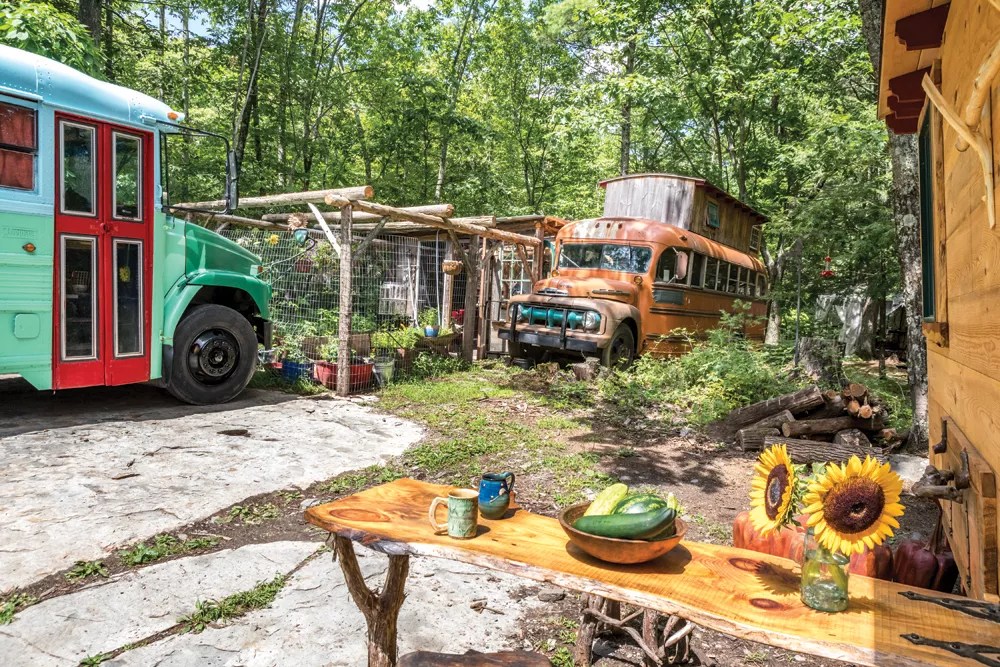
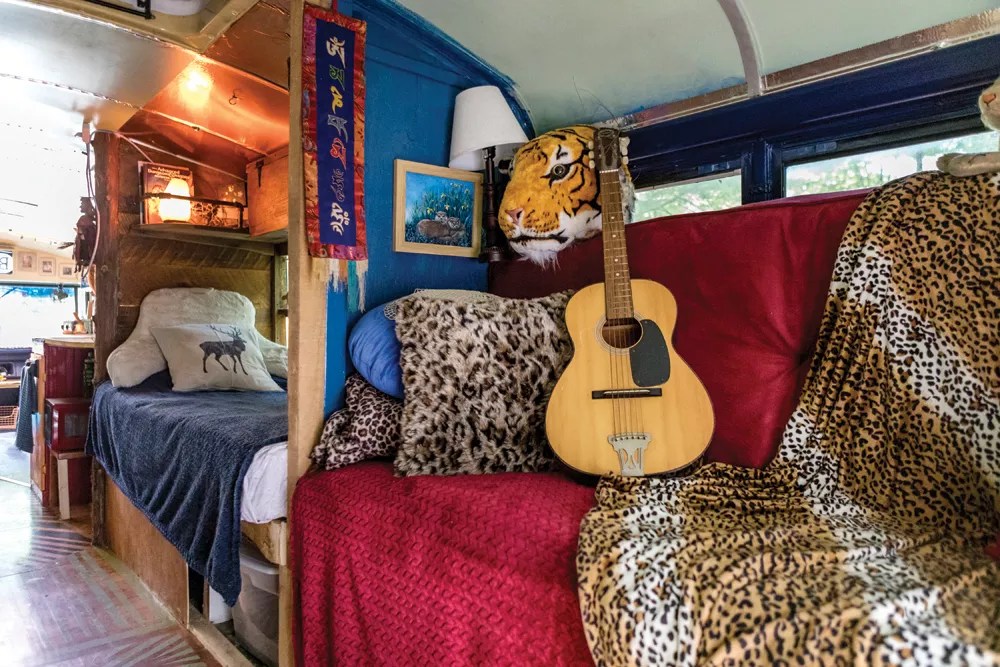
Snyder immediately began converting the bus into her permanent residence. First, she removed the bus lettering from the sides and painted the now multicolored exterior. Her brother, Curtis Snyder, a solar engineer with Crest Solar, installed 400 watt solar panels on the bus roof. She hired someone in the Bronx to remove the 44 original passenger seats and grind out rusted bolts. Next, she ripped up the rubber and plywood covering the metal floor, powerwashed the interior and sealed it against further rust, adding insulation as she went. With battery-powered tools charged from the solar bank on her roof, Snyder went to work creating the first incarnation of the bus’s 27-foot-long interior, building a kitchen, eating and sitting area, bathroom, closet space, and two sleeping spaces in the back. She added a removable wood stove for heat and designed each space to either convert to extra sleeping space or accommodate extra storage. She named her bus Brigantia after the Celtic goddess of victory, and for three years parked it on the street in Williamsburg while she was still working in Manhattan.
Bear Hearted
A series of life changes, challenges, and a little bit of kismet led Hoppy Quick down a similar path. A Catskills native whose family has been in the area since the 1600s, Quick has worked as a professional woodsman and carver for most of his life, earning himself the nickname the Bear Man for his distinctive chainsaw carvings of black bears. After splitting up from his wife, Quick was living alone in the house he had once shared with his family but was descending into a deep depression. “I knew I needed a change,” Quick remembers. A discussion with his two daughters led him to the conclusion that he was ready to lead a more bohemian lifestyle. He recalls the moment in 2016 when he decided to let go of his old life and ready himself for something new. “I sat on the edge of that cliff and I just let it all go,” he explains. At that point, everything seemed to fall into place.
Quick also decided he wanted a bus, preferably vintage. The next day, he found a picture of a 1951 Ford F6 school bus online. It was for sale in Connecticut, but Quick didn’t have the money to pay for it. He posted the picture on Facebook and said to himself, “if I have acquired any spiritual power I need to manifest this.” When Quick awoke the next morning, there were two messages in his inbox. One was from an acquaintance who offered to buy him the bus in memory of her mother. The second was from another friend—a mechanic who wrote, “Hoppy, what’s the story of that bus? If you’re getting it I want to work on it, and I don’t want any money.” This was just the beginning of a series of serendipitous encounters that led Quick to acquire the bus and haul it to his property in Olive, where, like Snyder, he began the redesign himself.
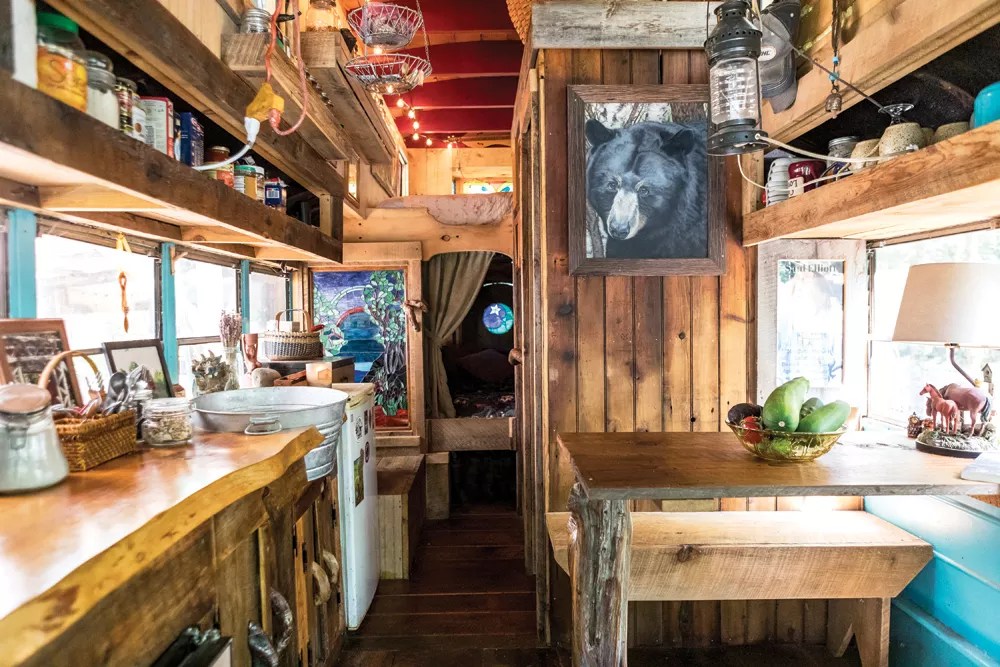
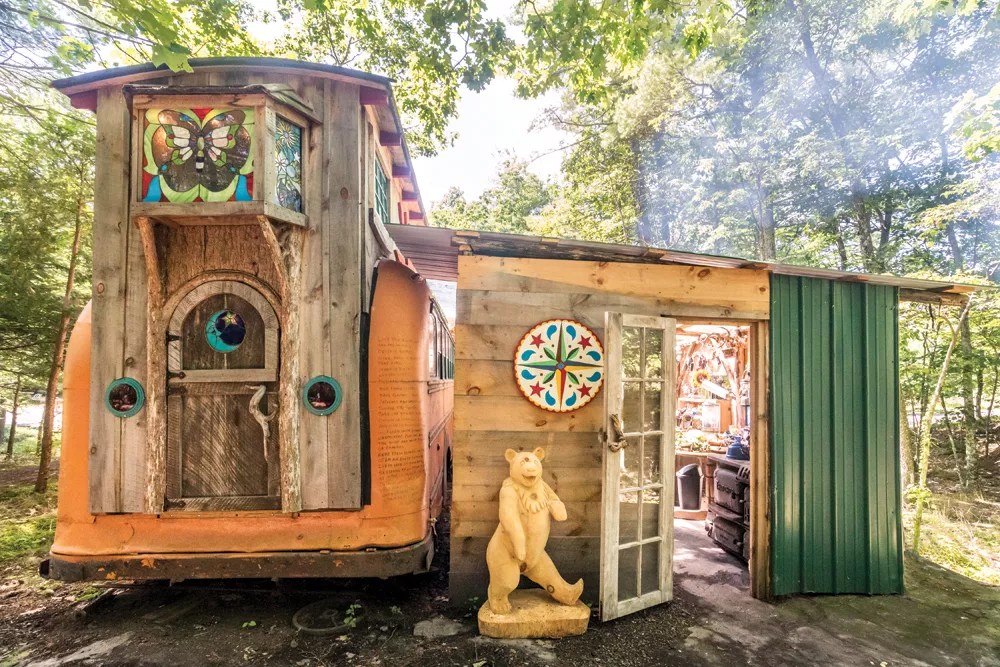
After tearing out the old interior, Quick used salvaged wood—including floorboards from the house of a close friend who had passed—to create a finely crafted interior space. In the front of the bus, Quick built a kitchen, with a slab wood table and benches, as well as a small bathroom. He cut out a large section of the metal back roof and built a wooden pop-up space for a queen-sized loft bed, installing stained-glass windows created by artist Dave Lombardi along the sides. “It’s a chrysalis on one side, a caterpillar on the other and then the butterfly,” Quick, who has a fondness for stained glass, explains. “I see it as my cocoon because it was something that made me really happy.” Quick named the bus Donna Grace in honor of the friend who helped him buy it.
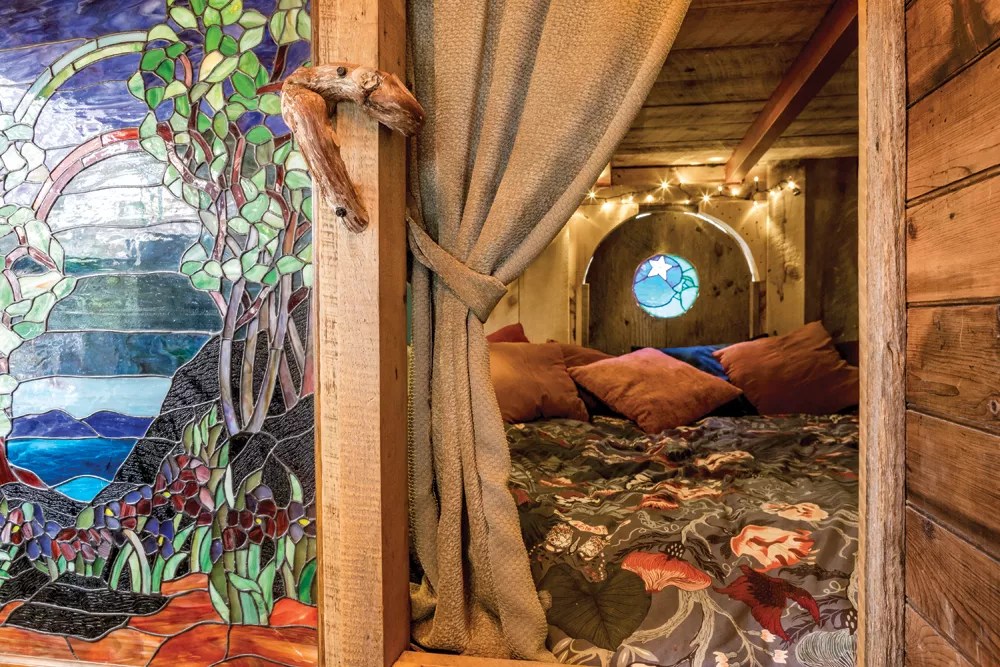
Bus Stop and the Bear Man
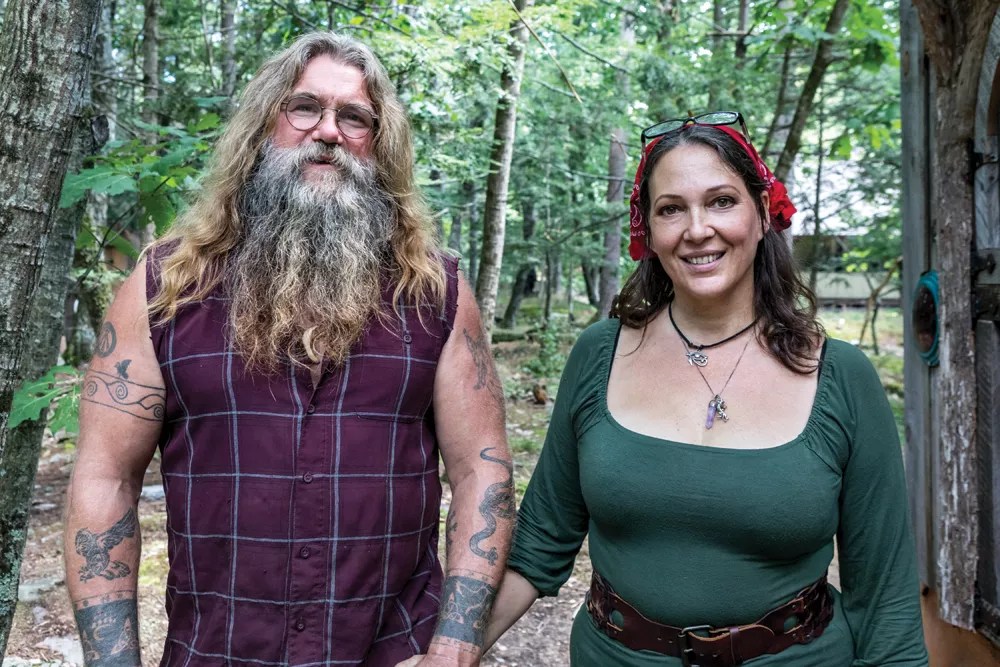
Snyder and Quick’s paths crossed in New Paltz when the 2017 tiny house festival brought Snyder and her skoolie to the area. (“Skoolie” is the affectionate term used by the community of owners for a school bus that’s been retired from service and repurposed as a living space.) “Most of the homes were tiny modular homes, I was the only school bus,” says Snyder. Snyder invited Quick to tour her bus and he realized he had met a like-minded soul. “I knew meeting Julie and seeing her bus was exactly what I came for,” he says. The two quickly became friends, realizing that in addition to their shared lifestyle vision, they had many other things in common. Not only were they born the same year, there were many other parallels in their lives. “Our artistic and bohemian tendencies are pretty strong,” explains Snyder. Their friendship grew and last year Snyder moved to the area full-time. The two parked their buses on property adjacent to Quick’s family property, combining their households and lives.
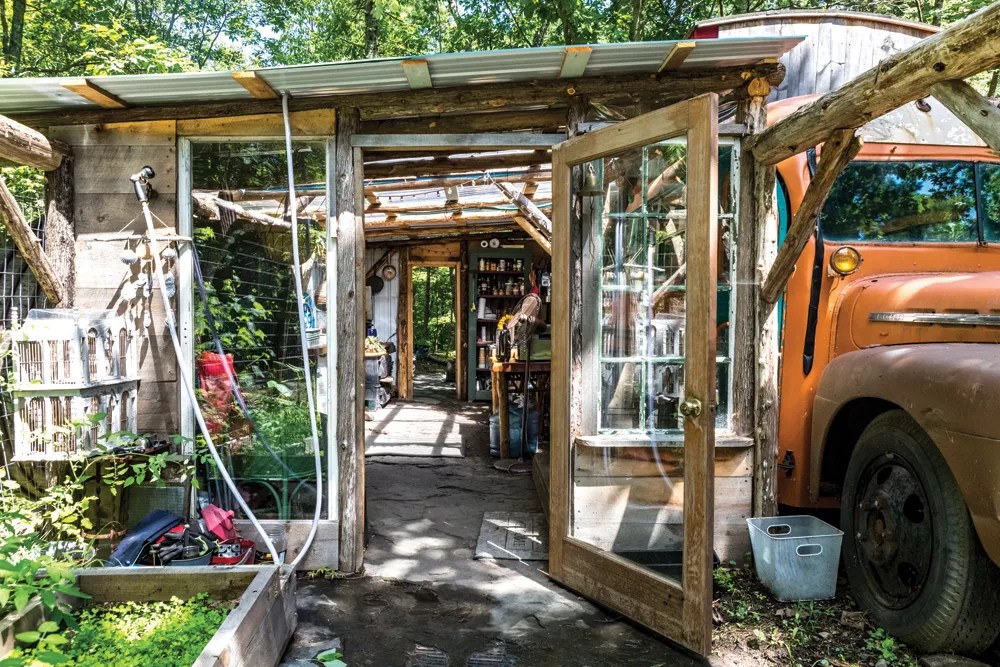
Since then, they’ve added an outdoor kitchen along the side of Quick’s bus, as well as an adjacent fire pit, dining gazebo, and garden. Quick built a propane-fueled outdoor shower nearby. Quick is also converting a Vardo wagon—a traditional horse-drawn wagon popularized by the Romani people of Europe—into guest quarters for their children or other friends to come stay. Their mutual love of their skoolies, which are both still drivable, has also inspired another change in their lives. Last year, both underwent training to become school bus drivers, earning their CDL passenger licenses. They now drive for the Onteora school district.
The pandemic has inspired both Snyder and Quick to refine both their buses and also share the skoolie lifestyle with the world. Snyder used the time off in spring to completely revamp the interior of her bus—rebuilding her kitchen table and refining her existing counter space. She also added a one-person tub, converting a former horse trough and then painting it dark blue and lining the sides with tile. In the back of the bus, she converted the space that was once her bedroom into a small art studio, with a handmade floating desk and a seat, salvaged from Shadowland Stages in Ellenville Theater, bolted to the floor. (The space still has a pull-out bed for guests.)

The pandemic inspired a new post from Quick, this one a video. “Be optimistic and plant seeds. Seeds are faith and a way to think of the future,” he suggested. The post went viral, with thousands of shares and comments, so Quick created another one, this one thanking viewers. His followers wanted more, so Quick created new video posts for 70 days straight—from March through May—hoping to comfort people, and reconnecting viewers with nature and a simpler lifestyle. The worldwide community inspired by Quick’s postings about their homes, shared lifestyle, and philosophy has continued to grow, inspiring one filmmaker to begin a documentary about him and the buses. “It’s not really about me,” explains Quick of the movement. “It’s about shifting consciousness back too empathy. It’s about getting back to the reality of nature. If we move with nature, we can survive. Anybody who plants a seed has hope.”
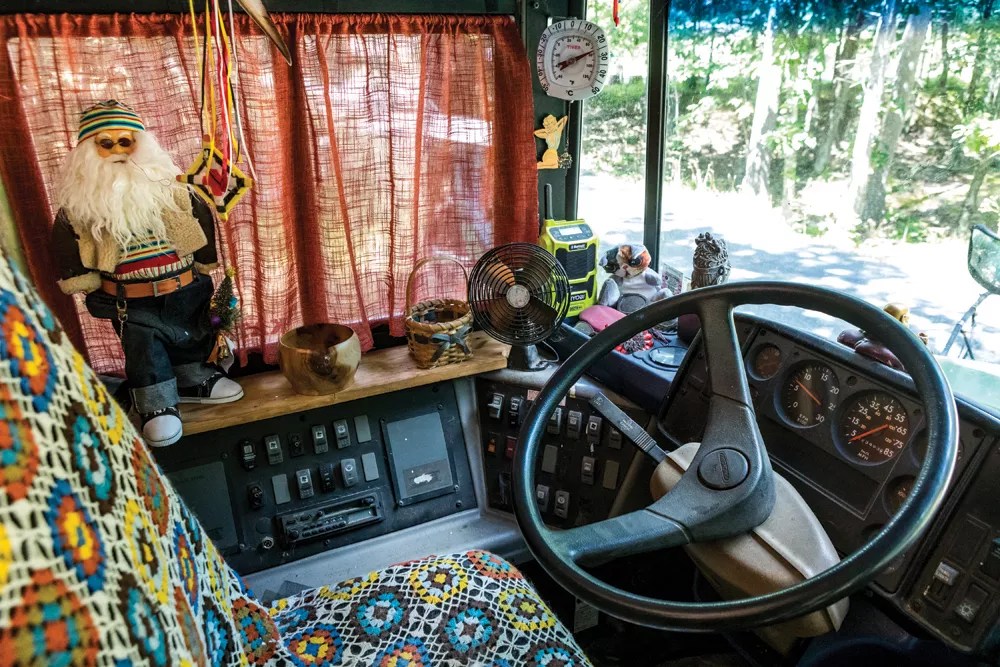
This article appears in September 2020.



Thank you Mary and Winona for this lovely article & photos of our homes❤️❤️