









The emotional bond between humans and dogs has been over 15,000 years in the making, a relationship that began with wolves hunting alongside early humans, a variety of breeds gradually becoming the loyal companions curled up on our sofas today. This connection is anything but ordinary. A simple scratch behind the ears or a warm touch of velvety fur can transform a pup into a whirlwind of wagging tails, eager licks, and uncontainable joy. Gazing into those wide, adoring eyes, humans find an age-old comfort—a wordless conversation between species that feels both timeless and immediate.
This feeling of wellbeing from positive interactions with dogs is acknowledged by scientific studies. Research shows that most dog owners get regular exercise—from walking their dog daily. Pet owners reported significantly less loneliness, better sleep, fewer days of work missed because of illness, and fewer doctor visits than those who did not own pets.
When dogs and humans interact in a positive way, both experience a surge in oxytocin. The release of this hormone is linked to positive feelings of emotional bonding, love, and attachment. “Oxytocin is called the love chemical or bonding chemical,” says Janis Bradley, director of Science and Behavior at the National Canine Research Council based in the Dutchess County hamlet of Bangall. For the past 20 years, the nonprofit NCRC has been analyzing academic research studies and summarizing them for a general audience.
Research shows that dogs bonding with their human caregivers is very similar to the mother-infant bonding in humans. “It’s fascinating to me how similar those relationships are,” says Bradley. When mothers interact with their infants, oxytocin is released into the system. “If you want to know which creature on Earth is most similar to dogs, it’s human toddlers,” she says. “In terms of how they form attachments, those emotional and cognitive connections are extremely similar.”
Professionals in the field “used to scoff at dog owners who talked about themselves as parents, and their dogs as ‘fur babies,’” says Bradley. “As it turns out, they [dog owners] were actually on the right track. The more people think about that, they’re more likely to be patient and effective with steering their dog’s behavior in the direction they want it to go.”
Positive interactions with dogs—a scratch behind their ears, stroke of their fur, playful speech and eye contact can also cause a decrease in blood pressure for their human “parent” according to research studies. “The decrease in blood pressure is similar to what you might expect after a few minutes of meditation,” says Bradley.
Therapy Dogs
Fostering that feeling of wellbeing in others is the goal of volunteers and their trained therapy dogs. These volunteers are invited to visit those who are ill, feel anxious, or depressed in hospitals, hospices, public schools, colleges, nursing homes and senior residences.
Dementia patients can become more social during a visit with a therapy dog. “They become talkative all of a sudden,” says Bruce Fagin, executive director at The Good Dog Foundation. He said that sometimes the interaction, “rekindles a memory of their own dog.”
Based in Hudson, the nonprofit Good Dog Foundation’s mission is to harness “the dog human bond to ease human suffering and support learning with animal-assisted intervention.” It was founded in 1998 by Rachel McPherson, author of Every Dog Has a Gift and an instrumental figure in changing the law that barred therapy dogs from visiting hospitals and other health care facilities.
Good Dog trains, certifies volunteers and their dogs to help people in hospitals, schools, nursing homes, and other facilities; trains professionals to work with their dog as part of an educational or health practice, and conducts research with hospitals and universities to advance the therapy dog field.
It subsidizes the training and certifying of therapy dogs, fielding them at no cost to healthcare, nursing, and education providers. Some 330 volunteers visit about 230 partner hospitals, schools, nursing homes, and businesses throughout the greater tri-state area and disaster sites across the country each year.
Fagin says that he began to realize the impact dogs can have on our wellbeing after 9/11. He had a conversation with a professional helping families cope with their tragic losses. “Very often, these families were so stricken, the horror of what happened was so traumatizing, that they couldn’t verbalize it. But, putting a dog in their arms somehow freed them to connect with their own internal place where all those emotions were locked up. Sometimes, they would burst out crying, but it was step one in the process of recovering from the trauma,” says Fagin.
A growing trend in the Hudson Valley and Albany is therapy dogs in the courtroom. “My dog is a court dog, he goes to courtrooms,” says Renee Payne, director of training at Good Dog. And post-pandemic, it’s no longer uncommon for therapy dogs to visit employees at their workplace as a boost for wellness and productivity.
Helping Children Recover from Stress
Anxiety and depression among children, common before the pandemic, has only increased since 2020. Good Dog contributed therapy dog teams and design guidance to a study on whether therapy dogs could help children recover from stress. The study proved that dogs, by themselves, can improve children’s mood and ability to cope with anxiety, finding, “interactions with animals represent a promising way to reduce the burden of childhood mental illness on a large scale.”
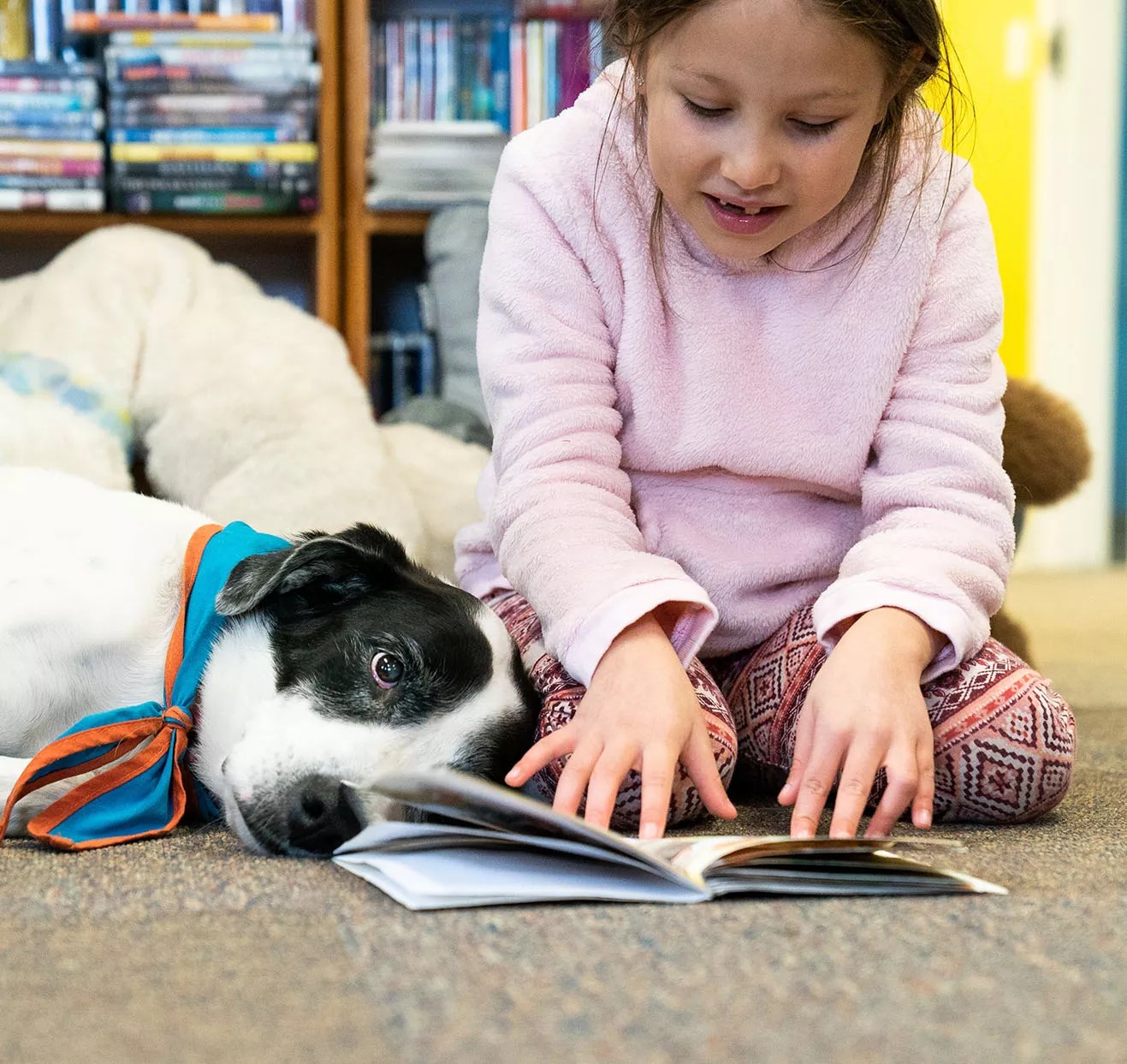
When therapy dogs are invited for school reading programs, the young children are invited to sit together on the floor in a circle. The child reading has a therapy dog on his lap. The overwhelming result for the child reading, is “the fear of reading out loud goes away,” says Fagin.

“When we visit college students at Julliard, they sit down on the floor and hug the dog,” says Fagin. “Their whole demeanor changes from being at the most competitive art school in the world to something else. And, when you ask them what they’re feeling, they say, ‘I feel like I’m home.’”
Pups, Prison, and Parenting
At least 60 percent of women incarcerated in the US have children at home under the age of 18. Female inmates often suffer from high rates of depression, self-destructive behavior, physical illness, and mental illnesses. In a jail setting, therapy dogs are integrated into the curriculum for female inmates. Classes substitute dogs for children in real-life scenarios to teach bonding, problem solving, direction, and encouragement. Good Dog, along with Pace University, designed a pilot program to see if specially trained therapy dog teams could help female inmates learn parenting skills.
“How do you discipline a child acting-out? You could use a dog as a metaphor, almost an avatar in that way: How do you discipline a dog without hurting it? All kinds of lessons in parenting also apply to people with pets,” Fagin says. The therapy dog environment enabled the women to trust each other as a class. “Each class began with a self-proclamation of how each woman was feeling that day, and the dogs helped mediate that whole process by creating a safe pathway,” says Fagin.
Therapy Dogs Help Improve Emotional and Social Wellbeing of Cancer Patients
Good Dog and Mount Sinai Medical Center New York partnered on a study to assess therapy dog benefits for patients being treated for advanced throat and neck cancers. These cancers are particularly brutal, with tremendous physical deterioration and emotional distress. The idea was to see if spending 15 minutes with a therapy dog during infusion, or before or after radiation, might have some impact.
The study proved that the emotional and social wellbeing of patients who spent time with therapy dogs during difficult and painful radiation/chemotherapy therapies improved significantly. “For the patients who spent time with our dogs, not only did they not deteriorate emotionally and socially, but they actually improved over their baseline,” says Fagin. “There were patients who even verbalized: ‘I came back for my radiation because of the dog.’”
On a personal note, I can attest to a similar experience. When my mother was in hospice for inoperable cancer, she always perked up and was more willing to sit up in bed, even take her bad-tasting medicine because she looked forward to the weekly visit—through Hudson Valley Hospice—from her pet therapy dog, Bowie Girl, a long-haired shepherd. This was a highlight of her day that she talked about for the rest of the week. Their bond lasted for a year and a half until my mother’s death in October.
Therapy Dogs and Corporate Wellness
Inviting therapy dogs into the workplace can improve morale, increase social interactions, and reduce stress according to a national study by the National Institute for Occupational Safety and Health. “The nonevaluative [i.e., nonjudgmental] role of service dogs or pets may be an important contributing factor to their therapeutic effects,” the study states, as a source of social support, “perhaps more effectively than a spouse or close friends.”

“Unexpectedly, post-pandemic, we started getting calls from businesses wanting therapy dog visits to destress employees,” says Fagin. “So, we did some research and the statistics were stunning; the leap in the percentage of adults who reported being anxious or depressed was amazing after the pandemic and probably reflects the complicated times we live in.”
The 2024 American Psychiatric Association’s annual mental health poll shows a steady rise in anxiety among adults as 43 percent report feeling more anxious than they did the previous year, up from 37 percent in 2023 and 32 percent in 2022.
After a few minutes interacting with a trained dog at their workplace, “employees start talking with each other and you see those conversations happening,” says Fagin. The workforce wellness visits, part of a corporate partnership initiative, also help Good Dog underwrite their charitable activities.
Charles M. Schulz, renowned cartoonist, creator of the iconic comic strip “Peanuts” may have said it best: “What is more happy than a little kid putting his arms around a warm puppy? If that isn’t happiness, I don’t know what is.”
This article appears in January 2025.

The River is an independent news outlet that produces in-depth, quality journalism and analysis about the Hudson Valley and Catskills regions. Learn more about our mission and ethics.


