








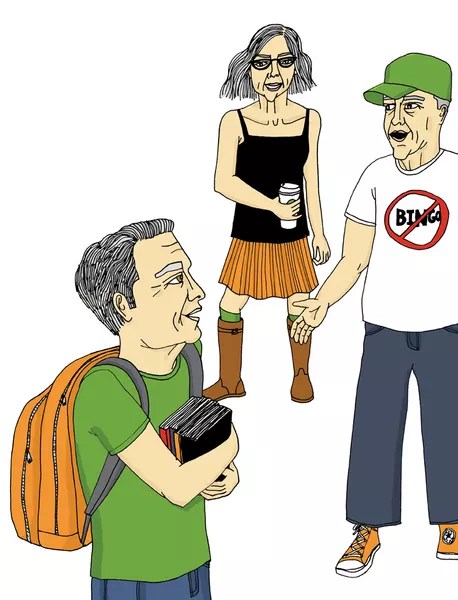
What if you’d enjoyed years of sumptuous meals and then suddenly had to settle for oatmeal? It can be like that for many retirees: after a rich working life, bingo just isn’t going to satisfy. Lifespring, a new adult learning community in Saugerties, is fixing that with stimulation for the mind and community for the soul.
An intriguing concept appeared in the 1970s: Create group trips and activities for the older set like those that younger people enjoyed through international hostelling. In 1974, Elderhostel was founded by David Bianco to provide “intellectual stimulation, personal growth, fellowship, exploration, self-discovery, and a lot of fun.” Today, as the organization is poised to change its name (neither “elder” nor “hostel” convey its flavor), millions of people are taking part in Elderhostel adventures. Among them are Lifetime Learning Institutes, or LLIs, which are locally organized on campuses across the nation. In the Hudson Valley, LLIs can be found at Bard College in Annandale-on-Hudson, Marist College in Poughkeepsie, Columbia-Greene Community College in Hudson, SUNY’s New Paltz campus, and Mount Saint Mary College in Newburgh. They are tremendously popular: Bard had to close to new members when its capacity maxed out at well over 200 people; SUNY New Paltz’s program had 175 people signed up at its opening.
But in Saugerties, where there is no college and no LLI, a new program is taking the lifetime learning model a step further. Lifespring: Saugerties Adult Learning Community aims to nourish intellect and curiosity while building a community-based social network. Lifespring is the cocreative effort of volunteers under the guiding vision of dynamic duo Susan Puretz and Arzi McKeown. Puretz is the program’s spearhead and president, McKeown its curriculum chair and consultant. The women met when Puretz asked McKeown to help out and bring her many years of experience at Bard’s LLI with her.
The women agree their collaboration has been magically synergistic, and for months they and a core group of dedicated volunteers worked on the program, which takes flight later this month as classes begin on September 22 at Saugerties United Methodist Church on Washington Avenue and Post Street, near the Saugerties library.
Hatching an Idea
The original inspiration for Lifespring arose as Puretz and her friend Barbara Kaisik were out walking, musing about Bard College’s popular learning program and wishing they could bring it “across the bridge” to Saugerties. But there was no college campus to host it. No matter: After putting their ideas together, they approached the town board with the concept of having it sponsored by the town. “They said they would love to!” Puretz recounts.
“Arzi and Susan have incredible energy,” says Saugerties board member LeeAnne Thornton, who is a teacher and acts as liaison between Lifespring and the town, sitting in on the meetings and helping with ideas. “They are very talented, organized, directed women, and with Barbara, they really took the ball with this and ran with it. There was a tremendous enthusiasm—about 25 people, with ideas flying. I’ve never seen a more diverse group of individuals, all wanting to do something to keep active. Local people have volunteered to get all this done.”
Winning town sponsorship meant tangible support that includes such things as a meeting room for planners, free webpage hosting and web design by the town’s webmaster, a cable access program where Arzi and Susan introduced the idea to the public, equipment loans for the classes, and about $500 start-up funds for copying and printing informational cards, brochures, and the like (for which community vendors have given discounted prices as well). “We have the same enthusiasm running programs for the kids,” says Thornton of Saugerties, “and we spend a lot of money in this community on what we think is important. Now we’re saying let’s do something for the adults of our community.”
Calling All Hungry Brains
Like the campus-based LLIs, Lifespring offers noncompetitive learning (no more exams!) on a diversity of topics worked out by the self-selected curriculum committee. McKeown has seen how hungry adults are to learn and grow. “Many people never had an opportunity to further their education for a variety of reasons—raising kids, their job, not having the finances,” she says. “Now they’re really desiring the knowledge and stimulation of learning, and they’ll have this opportunity at a very low cost.” Lifespring membership is $60 for any courses and social activities in a year (additional trips or events might have a small additional fee). Members can also take leadership positions by organizing or teaching courses, serving on committees, or organizing events.
“We are still curious and interested in new things,” says McKeown. “We want to keep our senses active and seek out new ideas and alternative perspectives from our changing, dynamic, information-rich society. Modern neuroscience shows that the adult brain retains the ability to change its structure and function in response to training and experience. The hippocampus section of the brain can expand when the mind and body are put to use with mental, relational, and physical activity.”
So Lifespring’s curriculum committee came up with four intriguing topics for its inaugural semester. The classes meet once a week—two running concurrently in the morning, and two in the afternoon—for a duration of six weeks. Members select one from the morning session, and one from the afternoon, or just one per day if they prefer. Friends or spouses may wish to attend the same classes together, or choose different ones that meet at the same time. Those who stay for both morning and afternoon sessions can share home-prepared lunches on site or patronize a nearby eatery together, supporting local businesses in the process.
The four courses this semester, in brief here (see Lifespring’s webpage for details), are:
“The US in World Politics: Democracy or Empire–or Both?” by college history professor Richard Phillips.
“Taking Charge of Your Health: Mind and Body” with six guest speakers covering such topics as stress reduction, brain health, sex after 60, and medication management.
“The American Songbook” by Bob Cohen, a wonderful storyteller and cantor at Temple Emmanuel in Kingston, whose musical tour will trace the underpinnings of American popular music.
“Hudson Valley History Sampler” with six guest speakers highlighting key phases of our region’s history and its future.
Upon hearing about these courses, some folks have said they wish they were retired so they could attend. As an example of why they’re excited, here’s the six-week lineup for “Hudson Valley History Sampler”: author Frances Dunwell on the Hudson River’s cultural and economic significance; local historian and researcher Michael Sullivan Smith on the role of the Dutch in New York; history teacher Matt Ostoyich on the masterminding of the US Constitution and the critical role of New York State, including Kingston and Poughkeepsie (where the ratifying convention was held); Tammis Kane Groft, deputy director of the Albany Institute of History and Art, on the Hudson River School of painters; David Keehn, director of the Stone House Museum, on the discoveries made using the steamboat and the transportation route afforded by the Hudson River; and Jay Burgess, communications director of Scenic Hudson, on the Hudson River Valley’s environmental milestones, as well as its future.
Community in the Making
Besides the intellectual enrichment, Lifespring’s foundational concept includes creating a social web. McKeown’s vision is that members spend the class day together and share in other activities and outings they conjure up. The network also gives elders a place to shine, letting others know of important personal strides and accomplishments. In many towns, especially rural ones, the chance to do so can be hard to come by. In Lifespring’s planning phase, a new community has already evolved. “What we’re doing is a microcosm of what we hope will happen in the program—people picking up creativity and energy from each other as they make connections,” says McKeown. “We are a community. That’s what we hope to create in the overall group.”
“People are saying they don’t have the opportunity to get out and mingle,” says Puretz. “That’s going to be unique for this type of program. For more satisfaction in life, it’s important to balance social activities that continue for a reasonable amount of time with activities that are single events. So, participants will have the chance to develop new strengths, use older talents, and discover new parts of themselves, not just by being in classes, but through the social interactions and the ongoing community.”
Matt and Sandy Ostoyich are among the devoted planners who showed up at the early meetings, were invited to be part of the core planning group, and have organized one of the courses as well (“Hudson Valley History Sampler”). Both have backgrounds in education (she as a high school librarian, he as a history teacher at Onteora High School and Ulster County Community College). The Ostoyiches are veteran adult learners. “We’ve gotten into the habit of going to educational summer school, so to speak,” Sandy explains, “notably Cornell Adult University, and taking classes as part of our vacations. We’re very enthusiastic about spending time that way. I find that what has made our retirement fruitful so far is being involved with others, and with projects that have a goal.”
“We’ve found that whenever we’ve attended classes,” says Matt, “they are interesting for the mind, but community also does take place. At Cornell, we developed a friendship with a couple from Long Island, and now we get together with them two or three times a year.” In their work with Lifespring, they have a chance to use their networking skills—“both electronic and personal,” Sandy notes with pleasure. “It’s a free-will undertaking, so those who are involved are doing it because they are really interested. We’ve met some really wonderful people already.”
Sandy has seen a gender disparity after retirement that classes can help mitigate. “I find that men are not as likely as women to go have lunch together or go to the movies, so they tend to be more isolated,” she says. “So when they retire and the work by which they define themselves is suddenly gone, unless they have a hobby or they are in community organizations, they don’t go out much and stagnate at home. So we’re hoping Lifespring will give people a chance to feel like part of the web of the community.”
Socializing and Health
Brain games to stave off memory loss and keep wits honed are hugely popular nowadays. But social interactions in their own right can be mentally and medically advantageous. For instance, a year ago, Ertel and colleagues at the Harvard School of Public Health finished analyzing data of nearly 17,000 people over age 50 with regard to social integration (time spent with a spouse, family members, neighbors, or in volunteer activities), and found that memory decline over six years was worst among the least integrated—twice as bad as memory loss among the most social people. The study’s authors concluded that social integration delays memory loss among elderly Americans.
Similarly, R. S. Wilson and colleagues at Rush University Medical Center in Chicago tracked for four years a group of 800 people at senior citizens facilities and in 2007 reported that those who described themselves as the most lonely had the highest rate of cognitive decline, with a significantly poorer and more rapid loss of mental abilities proportionate with their age.
Physical health also benefits from social activities, even if they’re not sports-oriented. A study that followed about 900 older people for five years, whose findings were published earlier this year by A. S. Buchman and colleagues, also at Rush University Medical Center, discovered that people who were more socially active did significantly better on tests of muscle strength and motor skills. The study’s authors concluded that less frequent participation in social activities is associated with a more rapid rate of motor function decline in old age. Just the impetus to get up and out of the house is physically helpful.
Social activities can also help ward off psychological depression, including the types that are unique to elders. “When people age, so many things go on that separate them from others,” says McKeown. The aging process is also a grieving process, she notes. “If your family and friends are dying, you get in trouble hanging around home with just your own thoughts. So it’s really important that people have the opportunity to engage with others. I would say that for most people [in a learning program] it’s the community that’s the most important.”
Blueprint for a Learning Community
Here are some key ingredients that got Lifespring underway and which can be replicated in just about any town:
• A couple of enthused people to get the ball rolling, who can enticingly explain the idea and enlist others.
• A core team of helpers who meet regularly to flush out the plan and handle tasks like publicity, curriculum planning, and site searching.
• A willingness to cocreate with others and consider anybody’s ideas, balanced with a discipline to hold to the original vision.
• The courage to boldly go where you have not gone before—like to the town board with your idea or to printers asking for a price break (where you may find very willing helpers).
• A little start-up money or donated materials and services to support initial stages.
• A desire to improve options for adults in the community (including yourself!).
• Publicity in the community, a lot of which is free in the form of word-of-mouth enthusiasm.
Creating a continued learning program like Lifespring takes some devoted people and lots of volunteer hours. But the nourishment goes both ways.
This article appears in September 2009.


