









Pauline Oliveros was a sonic visionary, a technological pioneer, and a spiritual force whose influence radiated from the Hudson Valley to the farthest reaches of contemporary music. Now, with the release of Deep Listening: The Story of Pauline Oliveros, filmmaker Daniel Weintraub offers an intimate, resonant portrait of this groundbreaking composer, performer, and philosopher.
(The documentary is available for streaming on Vimeo.)
Born in Houston in 1932, Oliveros began her musical journey with the accordion at age nine. Her early fascination with sound led her to the vanguard of experimental music in the 1960s, co-founding the San Francisco Tape Music Center alongside luminaries like Terry Riley and Morton Subotnick. There, she delved into tape loops, analog synthesis, and improvisation, laying the groundwork for what would become a lifelong exploration of sonic consciousness.
But it was in Kingston, New York, where Oliveros truly rooted her practice. For over three decades, she and her partner Ione, a poet and performer, cultivated a creative sanctuary in the Rondout neighborhood. From this base, Oliveros founded the Deep Listening Institute, fostering a global community of artists and listeners attuned to the subtleties of sound and silence. Her concept of “Deep Listening”—a practice of heightened sonic awareness—invited both musicians and non-musicians to engage with the world through attentive, compassionate ears.
Weintraub’s documentary, now available for home viewing, is a luminous tribute to Oliveros’s life and legacy. Drawing from rare archival footage, home movies, and interviews with collaborators like Laurie Anderson, Thurston Moore, and Morton Subotnick, the film captures the breadth of Oliveros’s impact. It’s not just a biography—it’s an invitation to listen more deeply to the world around us.
The film also highlights Oliveros’s technological innovations, including her development of the Expanded Instrument System, which allowed for real-time electronic manipulation of acoustic sounds. Her work with the Deep Listening Band, performing in resonant spaces like underground cisterns, exemplified her commitment to exploring the interplay between sound, space, and consciousness.
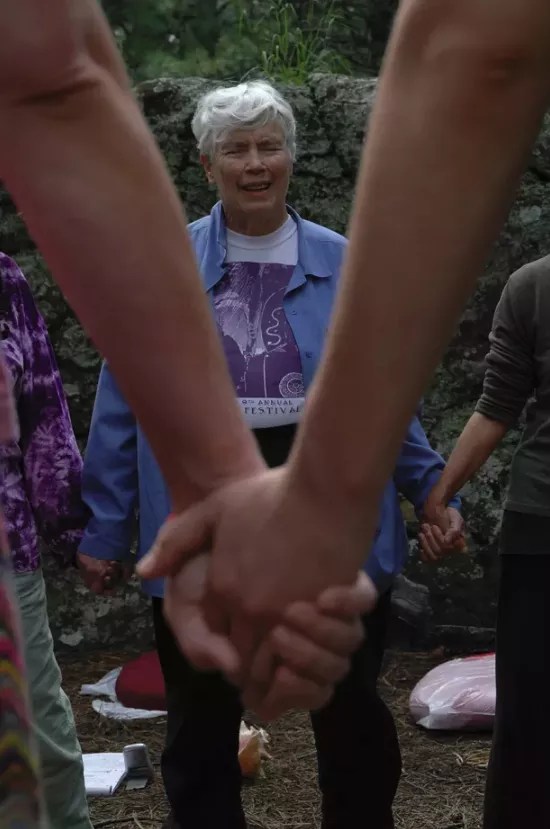
Oliveros’s influence extended into academia as well. She held teaching positions at institutions such as Mills College, the University of California, San Diego, and Rensselaer Polytechnic Institute, where she established the Center for Deep Listening. Her pedagogical approach emphasized inclusivity and the development of sonic awareness, encouraging students to engage with sound in innovative and mindful ways.
In the Hudson Valley, Oliveros was more than a composer; she was a community pillar. Her presence enriched the region’s cultural landscape, inspiring countless artists and fostering a spirit of collaboration and exploration. Her passing in 2016 left a profound void, but her teachings continue to resonate.
Deep Listening: The Story of Pauline Oliveros is more than a film—it’s a meditation on the power of sound and the importance of listening with intention. It serves as both a tribute to a remarkable artist and a call to embrace the transformative potential of attentive listening.
As we navigate an increasingly noisy world, Oliveros’s message is more relevant than ever: To truly listen is to connect, to understand, and to heal.
Related Stories

This article appears in June 2025.


